21 September 2011

Trolls!


Aaaagh! Trolls!?

Yeah, that's right kids. Trolls. Big beastly human-esque creatures, famous for hiding under bridges, eating children and billy-goats. They turn to stone in daylight, help orcs attack hobbits, are generally known for living on the end of pencils in the 1980's and have florescent pink hair.

Well now they're back.... in cinemas this week with the Norwegian release Troll Hunter.
"Whoa there Jon!" I hear you cry, "Are you now utilising your genius blog for film reviews?!"
Well no. I've not even seen the film yet. (Although I intend to catch it this week, I hear it's quite good). 


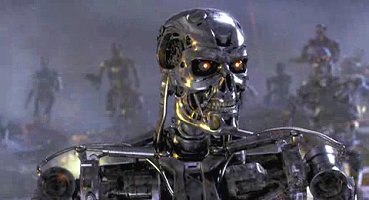
My trolls will be a cross between this
hideous ornament (but with a smaller nose)
and the more traditional troll image below.
I only bring it up as it reminds me of a film idea I had in 2006. It had a similar title ('Trolls') and was intended to be a supernatural suspense horror. After reading a Troll Hunter review I'm fairly convinced that my film is not at all similar. But it got me thinking that Hollywood will want to remake it. And then other troll ideas will come out of the woodwork. I'm sure other people have scripts involving trolls, but my point is that when I thought up my film 5 years ago, the troll phenomenon was a sub-genre that had yet to be tapped. (and no, I'm not counting the ridiculously terrible 80's flick Troll or it's hilarious, even worse, so-bad-it's-good, non-troll-related sequel Troll 2).

So I include here a brief synopsis of what my film is about, just so that when a similar movie does turn up on the big screen
(- and I'm sure it will, it's not just me out there with genius ideas you know), then you can believe me when I tell you I'd thought that idea up already.

A family (dad and two kids; Scott and Amy ages 6 and 9) move to a new neighbourhood. A country village. The mum died a year ago... of... well, of something. ...Let's just say she was tree surgeon, who one day had a fatal accident with a chainsaw. So a year later the family move (for his job) to a remote town... (always a remote town). I've not decided where yet. Initially I was thinking somewhere in deepest darkest Shropshire, Britain, or possibly somewhere in the US or Canada... but given our subject matter, it should really be set somewhere in Scandinavia. For the trolls in this tale will be the traditional folklore ones. They're 8 to 12 ft tall and as scary as shit.
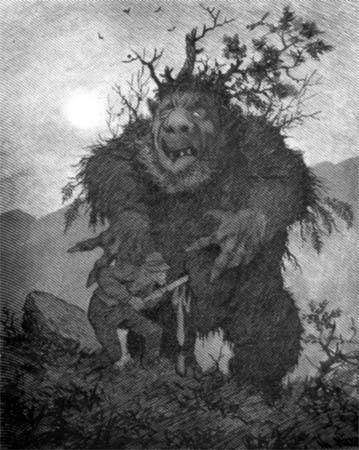

The pre-titles sequence has a lone troll wandering a riverbank at night. There is a lone fisherman doing a bit of night fishing (like you do). There's a troll POV shot, some swearing, screaming and some unpleasantness involving arms being torn from their sockets.Then titles.
Like most title credit sequences, we need to set the scene by having a sequence of helicopter shots of the family driving to their new town on a lovely sunny day.*
Near the start of the film, the dad (or perhaps the child-minder) is reading the youngest a bedtime story of The Three Billy Goats Gruff. (There is also reference to the cheeky colourful haired trolls in the child's bedroom.)

*Although it might be a nice idea to have it overcast/raining at the start of the film for a change. And only have sun where the plot requires it (kids playing in the woods).

So the first troll encounter comes the next afternoon. The kids are playing in a small wood next to the house. They find what they assume are statues or gargoyles half buried with mud and leaves (it's autumn). They also meet another local kid (Ross) in the wood. Ross swears he'd been playing in the wood throughout the summer but never saw these statues before. Perhaps someone dumped them there recently? They agree to meet up the following day at the statues.
Next day they meet up the by the statues. They're in more or less the same place, but it looks like someone had moved the positions a little. Then the discover the shapes/poses were somewhat different. 
It's getting late and starting to get dark, so they agree to meet tomorrow after school and the siblings head back to the house for their dinner. Ross hangs around playing with near the 'statues' with a stick ...or something (you know what kids are like). Ross is sat on the ground digging in the dirt with his back to us. We see the stone troll in the foreground right (and out of focus) begin to move. The child is oblivious...
Cut to next day. Monday morning. The kids join their new classes. There's a spare seat in Amy's class.... where Ross usually sits. He's reportedly missing.
That afternoon the police are round the school to ask the kids and their dad (who conveniently works there) questions about when they last saw Ross. Later Amy shows her dad and the police where they were playing... but the statues had disappeared. She says she thinks it was here. Then finds 'Ross Rules' written in the mud.   ... Then evidence of blood. The police declare it a crime scene. and the dad says he doesn't want his kids to play outside any more. So ends the first act of the film.

So you can see where this is going.  It's kind of obvious. The film practically writes itself. Perhaps it's not such a genius idea after all, but I'm surprised no one has done it already.

The second act has more killings (children and adults) but usually individuals on their own. There's an incident with a dog walker and their dog (ref: Jonesy the Cat's finest moment in Alien). It'll also feature some survivor sightings where people have got away. Initially they will be children telling adults of what they've seen (and adults inevitably not quite believing them), but eventually the dad and the cool local cop team up and it becomes a buddy movie.

Final act. It being the countryside, lots of people have shotguns and a group get together to hunt down this troll and kill it. They set a trap. But the troll doesn't fall for it. A couple of deaths later and they've got it. Dead.
Then what might otherwise be a nice epilogue has another troll sighting the next evening. The kids remember seeing at least 6 stone trolls in the wood. but as they don't know their current hide-out, the cop and dad and other troll fodder find one and keeping their distance follow it back to it's new den. It's still nighttime. All the trolls are there and then the humans are surrounded. There is violence. death. blood. gore, and things of that nature... generally. Whether one or two (or any) of our heroes survive the battle, the trolls turn to stone by sun up. And the authorities arrive to either a) get a pneumatic drill on their collective asses, b) blow them up with explosives or c) load one of them into a giant metal crate for future study. 
Unless option c above happens then I'll also have evidence to the viewer that they've missed one... a little further away from the others: One troll's stone hand is barely visible having buried himself in the ground. Roll credits. Commission sequel.


I've told a couple of people of this idea since, but one in particular who I worked with was an amateur film maker (when I knew him in 2008) who one day out of the blue just said to me 'Jon, have you any ideas for a good horror film?'... So I told him. He started taking notes. Then I said 'You're gonna steal my idea aren't you?'. He didn't answer he just smiled. I then said that I probably wasn't going to make the film myself  and asked that if he did, to give me a creative credit on the film.... No promises were made. I wish I could remember his name.
So if you're a film director/producer & you'd like a stab at this cinematic gem of genius, then be my guest. But please let me know or at least credit me for the concept. Ok, so the basic story structure is ripped off of M Night Shyamalan's Signs, except with trolls instead of aliens, but that's hardly original. In case you were wondering, also borrowed are ideas from Arachnophobia, Invaders From Mars, and any number of Stephen King films.
Scary as fuck.


28 July 2011

Gravity Part III: The End (The Life of the Universe ...and Everything)

The universe is an interesting place. I should know, I've lived in it most of my life. But how did it get here? Will it be here forever? And if not, what happens when it dies?
Various theories have been bandied about on the subject of the universe's longevity. It seems that the scientific community's jury is still out on these matters, so I think it only right for a probable genius such as myself to illuminate the truest most probable scenario.
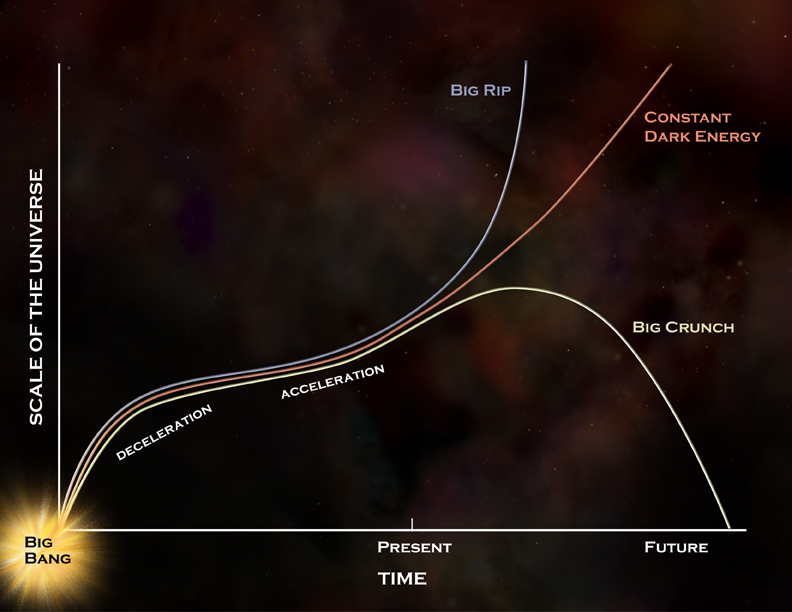
Current scientific speculation about the universe. All wrong for the most part.

Gravity is the key to the end of time. Of the current opinions, the most common ones suggest that either all mass in our universe will stop accelerating away from each other and then gravity will make it fall back on itself (The Big Crunch) ...or all the galaxies in the universe will continue to get further and further away from one-another, in which case after a stupidly long period of time, entropy will set in, everything will cool down and break up into their component atoms until they simply disappear. And the end of matter in the universe means the end of time itself. It is believed that this second scenario is the more likely of the two, because there currently isn't enough known matter in the universe for the first scenario to happen. Well I'm here to tell you that both of these scenarios are wrong...
...sort of.

It is my (unquestionably correct) opinion that the universe is infinite. That is to say that it's always been here. There is no start and there is no end. But there are cycles of similar (but not identical) repetition within. Time and space in the universe are not constant. They are infinite, however I will concede that it is acceptable to call them finite as time and space can only be measured in relation to something else. They are concepts that are relative to the observer and it is impossible to view the space-time continuum in a non-objective way. When I refer to the universe then, I am of course referring to everything and not perhaps 'the universe' as you would understand it.
Perhaps I should redefine this term. It is my belief that the universe as we know it is in fact just a small part of a wider universe. A multiverse or omniverse if you will. I will opt to call it the latter as multiverse suggests that the whole thing is just made up of multiple universes, but it's a bit more complex than that. Omniverse seems the right word to me at it means 'all', and in this case we truly mean all.

To begin with I reasoned the following idea to be a plausible model for an infinite omniverse:
All the galaxies in our universe are getting further away from each other... As there isn't enough matter to pull it all back together (because antimatter is probably responsible long ago for the annihilation of a great number of galaxies in our universe, hence the gaps. See Gravity Part II for more details on this phenomenon.), all the galaxies will spread out and disintegrate as mentioned in the 2nd scenario above. Eventually after what can be described as a literal eternity, all that's left of these vastly sparse galaxies is an innumerable number of basic component atoms. But this is where gravity comes back in, because even in an infinite universe with a finite number of atoms,... given a long enough time period (and we're talking an infinite time period here), all it takes is two of these atoms to collide in order to attract further atoms from across the endless cosmos. I should remind you that matter has a gravitation affect on all other matter in the universe, no matter the matter of the distance from the matter. It may sound fairly unlikely, but even if the effect of gravity didn't exist, so long as the atoms are moving and given an infinite amount of time these atoms will find each other... every time. So this is how new universes are born from dead universes. And that cycle goes on and on forever.

So, are you with me so far? Did you understand the basic principle laid out in the last paragraph. Okay, now I'd like you to forget about all of that, because as I said, the above was just my initial reasoning and I'd like you to see some of the workings of a genius mind such as my own. The true nature of the universe is so much more beautiful than that. It is far more complex, and yet it is a simpler solution at the same time. Allow me to explain in such terms that even a non-genius (such as yourself) can understand:...

My ultimate theory on the infinite universe states that there is only one universe. There are however an infinite number of universes that exist in a reality of there own. I call this a dimension-straddling omniverse. The basic model goes along with current scientifically known fact; there is a big bang, the universe is created, and then there's some time.... and 'some time' later the universe dies. The End.
Except it is not the end. It doesn't answer the question of what caused the big bang in the first place. It ultimately has to do with gravity. When a sun goes supernova and collapses in on itself it become a black hole. These black holes create new universes within the 5th dimension. The term 'black hole' is perhaps a bad description for the phenomena. It may appear black (because light cannot escape it's gravity) but it is not a hole. It is a singularity that sucks in matter, light and time. Effectively it's a pinched section of space-time.

The 3D black-hole effect on a 2D universe.

It may help you to imagine this on a 2D plane rather than the 3D plane we're used to. If space-time is represented by a tablecloth then a black hole would be represented by the effect that a vacuum cleaner would have when applied to that tablecloth. The hoover bag in this analogy represents a new universe. But this cosmic carpet cleaner is not within the 2D universe we know, it exists within an extra dimension.


Now lets add a couple of dimensions to the above tablecloth/hoover scenario. We have the 4 dimensional universe of space-time that we know and love, and then we have the 5 dimensional omniverse that consists of numerous 4D universes.
This all ties in neatly with my theory that gravity itself is caused by gaps in space-time displacing the continuum, as stated in Gravity Part I.

So, ... every black hole in our universe will create another universe. And our universe was created by the black hole phenomena of another universe. Although our universe is massive, it is also finite, and so every universe will create a finite number of universes. How many? ...depends on how many black-holes are created in a universe.

This* is not a literal representation of the omniverse.
At this stage the numbers don't really matter. Perhaps the effect of all black holes in one universe combine to create the same universe and so you would only ever get one new universe created out of the previous one. Or perhaps numerous universes are created from one, the number of which would entirely depend on the mass content and/or relative gravity of any given source universe. And some of those universes won't contain enough matter for gravity to take effect to cause more black-holes, but some would, and therefore create numerous universes within the 5D omniverse. Either way, each and every universe will have a finite lifespan, but the omniverse will be infinite. Every universe will be the product of every universe before it, and in theory all these can run parallel with each other: They don't have to happen sequentially in time as we're talking about space-time making more space-time outside of space-time. The effect will be like some kind of beautiful infinite cosmic omniversal fractal pattern. For every black hole, a universe is created, and within every universe that is created at least one (but more likely numerous) black-holes will form. It goes on forever. A universe is born and will die but the omniverse has no beginning or end. It's kind of like life. So long as life is around, more life will be created given the right circumstances. And as long as there is matter in the universe (any universe) then further universes will be created. Such is the nature of the omnivese, it has always been here and will always be here.

All the above is fact. Some of these facts may yet to be proven as 'facts', but that's for the scientific community to get it's head around. I don't have the time to wait for these supposed experts to catch up. Nor do I possess the time or resources to devote my life to such a simple (and obvious) cause as the nature of the omniverse. But take my word for it, this is the way it is. Fact.

Oh and for all the people with faith who believe that God created the universe: Some of you might want to embrace this new wisdom of mine, and try and explain that this scenario still fits with in your beliefs; that each universe is indeed created by an unknown higher power, that the vacuum cleaner in my earlier analogy is in fact God Himself, constantly creating universes from the remnants of previous universes, and technically being 'omni-present' within the 5 dimensional omniverse.... Well it isn't. It's not him. He doesn't exist. Get over it!


* Just some nice art work (admittedly pilfered from someone else's site) which nicely illustrates the infinite and procreative nature of the omniverse. It obviously doesn't look like that. The universes aren't even sharing the first four dimensions. Don't take it literally.


18 June 2011

The Grime Tunnel (Improving the Capital - part 1)

If you don't know me, you won't know that I've spent the best part of the last 10 months on the other side of the world (in New Zealand to be precise), imparting my genius-like words of wisdom to the local Kiwis, without being too condescending or self-righteous as every good genius should. 
I returned to my semi-temporary home city of London just a few weeks ago and was confronted with a familiar problem. I have a love/hate relationship with London, and one of the things I hate about it is the pollution. Now these days it's obviously not as bad as back in the smoggy days of the industrial revolution, but there is still a problem. Not so much above ground*, but beneath it. On the underground.

*(Although the air is still obviously more polluted the closer you get to the city centre. I still claim that in a blind test, I could be led through the underground to anywhere, and when we resurfaced, one lung full of the air is all I'd need to state which zone we were in. …and not just because of the destination announcements on the tube.)

The terrible state of the underground air is none more obvious than when you blow your nose after a tube journey. What would ordinarily be a greeny-yellow mucus now looks like the contents of a smokers lungs. The cause is the underground air... or rather, the tunnels that the air blows through. They're around 150 years old, and for decades had coal-powered trains going through them creating such a build up of crap on the walls that it's still there today. 

The solution is a simple one: The tunnels need cleaning.
This is where my latest genius invention comes in. Ladies and gentlemen, I give you… 

The Tube Cleaner.  
...or possibly it should be called the Tunnelic Irrigation Train... (but that's not so good on account of the acronym.)

Basically it a tube train that cleans the floors, walls and ceiling of the tube it goes down. There won't be space for passengers; just a driver. Most of the 'carriages' on this train will hold water. Powerful jets of water (with perhaps a small eco-friendly detergent mix in it) will powerfully spray in every direction. They'll be a couple of carriages with thousands of steam-cleaning nozzles towards the front of the train, and one drying carriage at the back... this'll just be like a big hair dryer.

The train itself will move at a slow walking speed in order to ensure maximum cleaning efficiency. It will run at night. Perhaps only 4 or 5 hours a night between 1am and 6am when the tube is not in use by commuters. At this rate, and with only one cleaning train it might be several months before all the track has been covered, but then it can start again and keep those tunnels up to the shiny buffed-up standard that they would be if I was Mayor of London**.


Have I thought of everything?... You might remind me the the tube is electric, and getting live electric rails wet can't be a good idea. Well they won't be on when they're cleaned. The cleaning train will be self propelled and battery powered (which will recharge during the day). The track is completely dried by the last carriage of tube cleaner, and the cleaning process should stop by 5am, at least an hour before the passenger trains start again.
So why isn't this (some might say 'stupidly simple') genius idea implemented already? They do vacuum the tunnels each night to remove dust, but that hardly sorts out the problem. As far as I can tell, there are currently no wet or steam cleaning trains in operation on the London underground. If there were, my snot would not be grey.


**Incidentally, please don't vote for me... It'll be quite embarrassing for the government when I inevitably get voted in, and I have to turn the job down.

11 May 2011

Fate and Fiction.

This week I have been mostly thinking about the future.... and the past. And on thinking of these things I was also forced to consider thoughts about concepts of the present, fate, determinism, immutability and causality.*

In this particular blog I would like to answer some of the bigger questions out there about the universe and time. Does fate exist?... if so, can you change the future or is it as unchangeable as the past. Is time itself a human constructed concept? and does it even exist?

I was gonna give my genius spin on the subject of fate, choice and alternative realities anyway, but this week I saw the wonderful new movie by Zowie Bowie (Duncan Jones to you), Source Code. Without spoiling too much, it has Donnie Darko continually going back to 8 minutes before a train explodes. And he changes things.... He doesn't however change anything in his reality, but it's implied that every time something different happens to the original time-line, the consequences are played out in an alternative reality. I'm sure we all know how this works already; It's explained often enough in science fiction.
But is it only science fiction? Or are alternative realities actually as real as this one?
I think so. It is after all, the only way to explain away the riddle of fate and choice (which is what this blog was meant to be about in the first place).

Let's look at the alternative: A universe where multiple/infinite realities don't exist; where our reality is the only version, and there is only one sequence of history.

In such a universe, two more choices exist:
  1. The future doesn't exist and is therefore changeable. The only possible version of events in our non-deterministic universe are dictated by the choices we all make. This would be the perfect scenario for the way time works, were it not for the fact that in theory, time travel backwards is possible, and in fact time travel forward is also possible. This is because time runs at different relative speeds for an object travelling at speed compared to the relative space it travels through. So in a universe where you can go forward and back in time (and potentially change things to what was going to/supposed to happen), it's possible to create a paradox. (What if Marty had actually been a bit sick, and continued to date his mum?! He'd never exist to threaten his own existence)
  2. The future already exist and is therefore unchangeable. Again even if time-travel was impossible, it implies that the future is set, and nothing... nothing we do can ever change it. Personally I don't like this idea. It means that fate exists and that we're not in charge of our own destiny. Again in this version of events, if you had prior knowledge to what was going to happen, this would create a paradox.

The only way an impossible paradox is avoided is if the changes made to any time-line create an alternative reality.

But then there's the argument that if we occupy one of these infinite number of realities, and we're just one universe that happened in a specific way, then that implies that again we're fatefully destined to live out that specific version of history. Well I don't buy into this. If we are living in one of an infinite number of realities where the future already exists and only one version of events can happen, then I'm certain that the one version of events that we occupy fluctuates every time a conscious decision (or unconscious action) is made by any life-form on the planet. For every choice that is made, our universe becomes a new version of itself. Yes, we are living within a single reality amongst an infinite sea of realities. But we decide which one we're living in.

The future is not set.


*I don't know the meaning of at least one of these words.


03 April 2011

Your Own... Personal... Robot...

(Someone to hoover your stairs. Someone who cares)

In the future we will all have our own personal robots. Fact.

It may not happen in the next 20 years, the next 100 years or even the next 1000 years, but if it can happen then it will. Eventually robots will be part of our society. This we know to be true, cos we've seen it in so many films. Ok, these are science fiction, and many of these films will often have one or all of these robotic slaves going on a human killing spree, or at all-out war with humanity. But we've got years of human/robot harmony before all that happens.
(Remember: given a long enough time period, if it can happen, it will).

In the mean time, while we're waiting for the inevitable revolution/war/Armageddon/global genocide/enslavement of humanity by our robot overlords, a question has occurred to me: If society was capable of creating enough intelligent machines to do every job that man can do, then how would that work?...

Surely we'd all be out of a job?

Well this is exactly what people thought back in the last century when factories were becoming more and more automated. Not as much man power was required and many people were out of work.
But there's always other jobs right? If every person was replaced by a robot tomorrow then you'd think that'd be terrible.... but no.
Perhaps in the short term it might be a problem on a small scale, but if a company didn't need to pay a work force then that'd be a good thing. And here's why... Here's how the future society would work (in the few years of Human/Robot bliss, before the nightmarish apocalyptic world becomes a reality) if you put me in charge:

For every robot doing a human's job in government, the government will give free food to someone. They can afford to do this cos they won't be paying an individual, and because the robot works in a farm/factory that supplies the food.
If you expand this idea, then what you have is a semi-communistic society when everyone gets a minimum wage/minimum free food hand outs. And no-one has to work if they don't want to. There will still be free enterprise, so you can still get rich if you want outside of the system, but get this: No one pays tax. Why?... Well it's the future. What does the government need money for? Your bins are collected by robots. Your power is renewable energy, everything is free as it's run and maintained by robots, who don't need paying. There will never be roadworks again. Everything that needed doing is now future-proofed, so that if ever there was an issue with something, it can be fixed, instantly, by robots. Everyone will get free hand-out/credits... unless you're actually working yourself. But the money you earn is not taxed. There is the great incentive to work, but if you want to live a life of leisure, you can. Most people won't need to retire, as they're not working, and there will be no more pension adverts on TV. Your funeral is even free, (unless of course you actually want a freelance human priest to conduct the service). Robots can do everything.
This is all the more easily integrated globally if the whole world is as one and at peace.

Have I missed anything out? Who pays for the robots?... initially the government. But once a few robots are made, these are put to good use in robot-making factories. And before you know it, you'll have 6.5 billion automated, soulless, (potential) killing machines on the planet, ready to do a bit of hard graft for humankind, so that I can put my feet up, watch some TV and perhaps spend some more of my infinite free time painting, without worrying about where my next semi-communistic, government-issue, robot-prepared ready meal is coming from. Is that too much to ask?


06 March 2011

The Hoverboard


I came up with a (very) rough plan for this a few years ago, and recently a friend of mine (Hello Liz! *waves*) reminded me of this genius idea.

While the means of hover/propulsion have changed in my head several times and this is still very much a work in progress, I figured it was time to state on these pages how a Hoverboard might actually work. ... after all, it's 2011 already that gives us less than 4 years to come up with the goods.

I assume that hover-boards work using the same technology that let cars fly (again, only 4 years to go... come on people!) But I'm sure a flying skateboard is easier to design than a flying Delorean.

So what lifts it off the ground? ...First I thought how about jets of air? … This would basically make it a mini hovercraft but without the skirt. (which really wouldn't make it very effective or stable.)


Ok...Plan 2. How about magnetism? On the base of the board are powerful electro-magnets. This makes more sense to me. It would require there to be a similar magnetic force on/under the ground to that the board is repelled from the earth. The power of the boards electro-magnets can be turned on or off instantly, and perhaps there are sensors on the top of the board so that it knows how heavy the user is (like electronic scales), and therefore adjusts the power of the magnets accordingly... Or maybe even simpler, there are detectors on the underside of the board that tell it how far it is from the ground when it's switched on (these can be lasers or an infra-red beam reflected back to the board) so that the power is automatically adjusted to keep the board a set distance from the ground, regardless of it's user. The magnets would have to be directioned at all angles including up, otherwise the board would instantly flip over as soon as you turn it on.


I've probably not thought of everything, but I'm pretty sure that it would definitely work. The only problem being that it requires polarised magnets under the floor everywhere that you want to hoverboard.... That and the small probability that the invention will turn out to be a death trap.... but hey, let's deal with one problem at a time.

Does anyone think the idea's developed enough yet to sell to Mattel?


27 January 2011

Gravity Part II: The Sequel (A Life and Death of Matter)

So I thought up this theory whilst reading up on antimatter. Incidentally... I still think my gravity (part I) theory is still excellent and valid, but in the very unlikely event that I may be wrong on this, what follows is an equally well thought out and plausible (& even probable) reason for why matter is attracted to other matter.
I'll keep this brief and to the point so you can understand it (We can't all be geniuses* like me).

My theory simplified goes like this: Matter is actually only attracted to Antimatter. Matter is unnatural and chaotic. The universe wants to revert back to it's original state of no-matter.... and so all matter gets sucked into antimatter.

A quick lesson on antimatter:
Matter exists in the universe. Antimatter also exists. This explains where that matter came from. You don't get owt for nowt, and you can't get a universe containing matter, without creating an equal amount of antimatter. Matter comes into being and is then destroyed with the separation and then amalgamation of matter and antimatter. The current problem for scientist is this:.... they haven't found nearly enough antimatter in the universe to account for all the matter.

************************************
************************************
******** INTERMISSION ********
************************************
************************************

Welcome back to Gravity Part II.
My theory concerning why matter is attracted to matter... The simple answer is: It's not! It's attracted to antimatter. Yep, that's my theory.... That inside every sun, planet or moon is some antimatter that sucks in all matter around it. This explains the whereabouts of all the antimatter that physicists are looking for in the universe, and it also fairly simply explains why all large masses have gravity.

Most of a planet's mass will be regular matter, but some small fraction of it in the centre will be made of antimatter. The antimatter will be a lot smaller in size and therefore much denser. So... if the Earth and the Sun and every heavenly body has antimatter at it's heart, then why doesn't everything just disappear?... Well that's all down to the fact that everything is spinning. It's the centrifugal force that makes all matter want to escape from the antimatter that would otherwise affect it. Even in supposed zero gravity, if you spin a bucket of water around fast enough, the water should stay in the bucket. (Law of inertia: Things'll keep moving in the same direction at the same speed unless there's some other force to make it slow down or make it change direction).

So it's the same throughout the universe. The Earth spins. It's matter is kept from destroying it's self thanks to it spinning. Just like the planets going round the sun. If the planets were static, the sun's gravitational pull (thanks to the mass of antimatter at it's core) would suck every planet into it. The sun (and our entire solar system) is travelling round the whirlpool that is our galaxy The Milky Way. At the heart of the Milky Way is a very large dense amount of antimatter (this is basically what a black hole is) and this sucks much of the surrounding matter in. As the milky way is spinning I'm uncertain as to whether all it's matter will eventual come into contact with this antimatter, but it depends on how fast it's spinning.

Finally every galaxy has it's own place in the universe. Scientists have been able to map the whereabouts of many galaxies and a pattern has emerged. The galaxies form a kind of random stringed web pattern with great big gaps in between, but know one has known why these gaps are there. I can now reveal that these massive gaps of nothingness in the universe are where there used to be galaxies, but galaxies where matter and antimatter have returned to one-another. Perhaps they weren't spinning fast enough to survive, or perhaps there happened to be more antimatter than matter (in which case maybe other galaxies have more matter than antimatter to make up for the imbalance). Or maybe they were the oldest galaxies and they had just run their course, indicating that perhaps all galaxies are destined for this fate of nothingness.

Now once again, I'll remind you that I'm no astral-physicist, and at the moment, these ideas are just ideas. But they do answer several unanswered mysteries. Perhaps the science community need a possible genius like me to point it in the right direction. I'm not saying I'm definitely right**... but I'd like to see some conclusive proof that I'm definitely wrong before someone brands Jonisnotagenius NOT a genius.


* Or should that be genii?
** Let's be honest, I probably am.