Here's a quick energy generating idea. As well as all the usual green ways of energy production, why not tap into the wasted energy of breaks on a train.
You'd still keep the breaking mechanism on a train as a safety measure for the driver (and also for slowing near bends), but primarily breaking entering a station can be done by 'break turbines'. These are just a number of large turbine wheels built under the sections of track approaching the station, which will connect with long strips of break pad under each carriage. The break turbines will be adjustable from the signal box, so that they're only there if a train needs to stop. The turbines can be lowered so that they don't affect through-trains not intended to stop at the station.
For trains that should stop, the whole thing will be automated. There will be sensors on the track that register the speed of a train's approach to the station. The computer then knows how much pressure the turbine breaks need to initially exert on the train. This pressure is then gradually released until the train comes to a smooth stop at the platform.
Every time a train pulls into a station, a turbine will be turned which will generate electricity. Imagine the amount of power generated if every railway and tube station had these turbines spinning every time a train approached a platform. Enough to power the trains? Probably not, but I imagine there'd be a lot more force there than in wind or tidal power.
Naturally it would take much time and expense to convert both stations and trains to this method of breaking and energy production. But once all up and running, I should think they'd easily pay for themselves within a year.
Also, it would be easier to include this genius idea within the designs of new trains and train lines, rather than retrofitting it to existing ones.
I really like the proposed idea of the almost-frictionless vacuum tube train system* that they're gonna build in the USA or Japan**. I hereby give them permission to use my train break turbine generator idea as part of it's design. Just let me know if you've any questions guys.
* AKA The vactrain. A genius idea that's so crazy, it's like the sort of shit that I'd make up.
** I figure one of these 2 countries is bound to do it first.

Showing posts with label Inventions. Show all posts
Showing posts with label Inventions. Show all posts
09 October 2013

07 October 2013
Perpetual Super Fluid Motion
Yep, I'm giving the old perpetual motion machine a third and final stab.
Before I explain it in detail, I'd like to remind everyone that I am not a mathematician or a scientist, and my understanding of theoretical physics is basic at best. So perhaps you can chalk this one up to 'great idea, but the numbers don't quite add up'. On the other hand, perhaps I've stumbled upon something that no-one else has, and would therefore need to seriously consider removing the negative adverb from the title of this website.
It's all about superfluids. As with all my 'genius' ideas, this one is fairly straight forward ...(and ill thought out).
If you cool helium down to at least 2 degrees above absolute zero, it becomes a superfluid. Superfluids have many interesting properties. One of these is that they have no surface tension, and will continue to flow at a thickness of mere atoms over itself, the effect of which means it can effectively flow up the side of a bowl. My idea exploits this property.
If a superfluid can crawl up the vertical side of a bowl with a minimum of encouragement, then I see no reason why the same substance can't flow up the lesser angled slope, of a hellical structure. A reverse helterskelter if you will.
If enough liquid helium we're to make this trip, then at the top, when it reached an appropriate shaped spout, it would fall through a traditional water wheel turbine. This turbine would produce electricity. The superfluid would then return to the shallow pool where it came from, then it continues the cycle of moving up the hellical tower.
Now, if enough liquid helium was used in enough helterskelter/turbine systems, then a greater amount of electricity can be generated. In fact there has to be an optimum quantity of superfluid per turbine for it to run most efficiently (cos you don't want a surplus of superfluous superfluids). On top of this, there has to be an optimum scale of the turbines to produce the greatest amount of power, as well as an optimum number of such turbines per squared metre to produce the most power by recycling the liquid helium as efficiently as possible. If you take all these variables and make this gravity-defying liquid powerstation (for that is what it is) as energy efficient as possible, then you'll have your solution as to whether super fluid perpetual motion is possible.
Once you've figured out the optimum measurements, quantities and ratios, then you need to figure out the optimum freezer configuration, (which is to say, the minimum power input needed to maintain the necessary near-absolute-zero temperatures).
So then... you've figured out the maximum possible power output for the most energy efficient turbine/helterskelter/superfluid configuration (A), as well as the minimum power input required to keep this machine constantly cooled at the most energy efficient level possible (B).
Then you just do the maths to see if the machine can power itself as well as produce extra energy...
A - B = C
If C > 0 then you've got yourself a pepectual motion machine!
You're welcome.

29 September 2013
Beep Beep
I almost find it ridiculous that in this day and age, a new car still only has one beep sound for it's horn. A sound that is supposed to convey numerous messages to fellow road users, from 'Cheers mate!' and 'look out, I'm approaching the corner' to 'Get the fuck out of my way! This is my road!' ...and everything in between. The only current difference between all of the above, is the length of the beeeep.
Cars should have more than one horn sound.
I'm not suggesting that you have a great myriad of polyphonic sounds, just three or four alternative beep sounds, which better articulate the sentiment you're going for.
For example, for a simple 'Thank you' noise, you're going to want a lighter meep-meep sound - not too dissimilar to the horn on Postman Pat's van. You know the one. Everybody knows his bright red van. So Pat's got that one sorted already, but what if he's in a pile up? What if Ted's truck's broken down, and Pat's got an urgent delivery for the vicar? He's gonna want the extra aggressive grunt in his beep. If only to help him let of a little steam. Unfortunately he's only got that little 'meep' horn; It doesn't really do the trick when what he really wants to say is 'Yo momma!' to Ted Glenn.
This could have also been a contributing factor for Post Office workers who have been known to 'go postal'. Despite the inadequacies of Pat's van, it has been recorded for the record that he feels he's a really happy man. Mind you, that was before news of the Royal Mail's impending privatisation.
The multi-horned car is an idea I came up with many years ago. In the interim I've heard one or two other people mention the same idea to me independently. I definitely thought if it first though. Oh, what's that? You came up with the idea too? ...When was that?... Oh really? Well I thought of it about five years before then.
14 August 2013
Improving the Capital - part 4
So tell us Jon, tell us how we can make London a less crappy place to live.
Why should I?
Because geniuses are few and far between and you're so awesome, I just know you'll have another genius idea to improve the capital.
You're right. I am awesome.
And with that, Jon stopped talking to himself, turned away from the mirror and returned to his antiquated electronic writing device to type out his latest idea in a most unconventional manner.
After a while he decided that writing his blog in the third person probably wasn't his greatest idea, and that hopefully nobody would notice when I reverted to the first person half way through a sentence....
Seamless!
So as promised...
Picture the scene. You're a London local. You're in a tube station. You're on your way down the escalator towards the station platform. And because you're not an idiot or a tourist, and you understand the English language, you'll know you have the choice of either standing on the right or walking down the left side of the escalator.
If your not a small child or an elderly person or an American, then you'll have chosen to walk down the escalator as every able-bodied adult with even the loosest understanding of the concept of gravity should. But then you have two further types of people to contend with...
There'll be the usual moronic-foreign-elderly-child type of person who's stood on the left of the escalator. You need to be patient with these, and ask them politely to move out of the way. Some people ought to know better, but it's quite hard to tell from behind which of the people are simpletons and which are just arseholes.
Then there's the tailgater. The teenager who runs down the escalator who then has to stop becuase you're in the way, and then continues just inches behind you. The city-boy with the stupid pointy shoes who has to leg it down three steps at a time. The businessman who absolutely must get to the platform in order to get the train that's waiting there, lest he miss and have to wait for the next train, all of 90 seconds later. Run businessman, run! Oh my god, I can hear the doors beeping already! Quick! RUN!!
Pedestrian tailgating is not nice. You can hear them coming, then you're ever conscious that they're just behind you. No, I will not speed up for you. I usually walk faster than most people but I'm not going to speed up going down a staircase, let alone a staircase that's moving. Nor am I going to find a place to my right to move to so that you can go past. I like my personal space. Why are you in such a rush in the first place.
The solution of course is obvious. Have a third option; Are you going to take the stairs, the escalator, or the slide?
Fun for kids. Great if you're genuinely in a rush. Perfect if you find that walking speed plus the speed of an escalator isn't fast enough for you. There could even be an extra steep slide... just for thrill seekers and really impatient people.
If that's not fast enough for you (and let's face it, we're talking about the arseholes who always need to be some place 5 minutes ago), then you can choose the fireman's pole. No training given. Use it at your own risk. And if your maximum acceleration due to gravity isn't enough for you, then I'm sure we can think up some sort of explosive upside-down human cannon.

Why should I?
Because geniuses are few and far between and you're so awesome, I just know you'll have another genius idea to improve the capital.
You're right. I am awesome.
And with that, Jon stopped talking to himself, turned away from the mirror and returned to his antiquated electronic writing device to type out his latest idea in a most unconventional manner.
After a while he decided that writing his blog in the third person probably wasn't his greatest idea, and that hopefully nobody would notice when I reverted to the first person half way through a sentence....
Seamless!
So as promised...
Picture the scene. You're a London local. You're in a tube station. You're on your way down the escalator towards the station platform. And because you're not an idiot or a tourist, and you understand the English language, you'll know you have the choice of either standing on the right or walking down the left side of the escalator.
If your not a small child or an elderly person or an American, then you'll have chosen to walk down the escalator as every able-bodied adult with even the loosest understanding of the concept of gravity should. But then you have two further types of people to contend with...
There'll be the usual moronic-foreign-elderly-child type of person who's stood on the left of the escalator. You need to be patient with these, and ask them politely to move out of the way. Some people ought to know better, but it's quite hard to tell from behind which of the people are simpletons and which are just arseholes.
Then there's the tailgater. The teenager who runs down the escalator who then has to stop becuase you're in the way, and then continues just inches behind you. The city-boy with the stupid pointy shoes who has to leg it down three steps at a time. The businessman who absolutely must get to the platform in order to get the train that's waiting there, lest he miss and have to wait for the next train, all of 90 seconds later. Run businessman, run! Oh my god, I can hear the doors beeping already! Quick! RUN!!
Pedestrian tailgating is not nice. You can hear them coming, then you're ever conscious that they're just behind you. No, I will not speed up for you. I usually walk faster than most people but I'm not going to speed up going down a staircase, let alone a staircase that's moving. Nor am I going to find a place to my right to move to so that you can go past. I like my personal space. Why are you in such a rush in the first place.
The solution of course is obvious. Have a third option; Are you going to take the stairs, the escalator, or the slide?
Fun for kids. Great if you're genuinely in a rush. Perfect if you find that walking speed plus the speed of an escalator isn't fast enough for you. There could even be an extra steep slide... just for thrill seekers and really impatient people.
If that's not fast enough for you (and let's face it, we're talking about the arseholes who always need to be some place 5 minutes ago), then you can choose the fireman's pole. No training given. Use it at your own risk. And if your maximum acceleration due to gravity isn't enough for you, then I'm sure we can think up some sort of explosive upside-down human cannon.

11 June 2013
Science Friction (Perpetual Motion's Nemesis)
These days I seem to be posting my ideas more infrequently. Which is to say, I've been posting my ideas more sparsely, with a higher rate of infrequency, and in fewer abundance. Which is to say, in plain English, I've been posting less inperiodically or more commonly less frequently more often.
It is for this reason that I challenged my genius brain to come up with an idea that will solve more than one of mankind's problems in one go. We're talking killing two birds with one stone. But I didn't want to stop at two. Anyone who knows me knows how I love to maim a multitude of feathered creatures with one projectile, but on this occasion I decided to leave them be, and just think about the problem I'd set myself. Well within 15 minutes I came up with a single concept that will help reduce humanity's social, environmental, technological, residential and economic problems. All you need is a few decades work on an international scale, in a large section of Antarctica.
(an area of 500km radius around the south pole to be exact)

Problem 1.
The prisons in [insert country here] are full, but people keep doing crimes.
Solution: Send all the world's prisoners (or all the lifers at least) to one massive prison on an island. Perhaps not such an original idea. It's like when the US used to send criminals to Alcatraz. ...or when the UK used to send criminals to Australia. (In retrospect we call all agree that the latter was a terrible idea).
A large prison will be built in the centre of the continent of Antarctica, which (when the prisoners have finished building it) will be escape-proof. Anyone leaving the prison complex to go outside is essentially committing suicide. This of course is illegal, and will be punished by 24 hours isolation in the cooler.
Once it's up and running, a vast majority of the worlds prisons can be closed. ... and then converted into budget housing. I'm not suggesting people will live in cell-sized flats. (not everyone anyway) I'm saying you could knock though several cells and have an apartment that was made up of up to 5 cells. Luxury.
Problem 2.
How can the world save money on the space program?
Solution: You'd have a lift into space. Yes, this isn't a new idea, not even by me. But it is an idea I came up with many years ago. I've adapted it though, so that the base of the lift is in the Antarctic (to capitalise on the very cheap/free labour among the local residents), and the counterweight at the other end is in a low orbit in space, but at an angle (of maybe 60°) from the base. The counterweight can make several orbits of the Earth each day in the opposite direction that the Earth is turning. The base in this new design however is actually anchored to a platform that moves around a large track with a circumference of approximately 3142km around the South Pole (again, built over many years by convicts). The speed of the platform around the track can be altered any time the lift needs to be used. Why the track? Well this is part of the answer to my third problem...
Problem 3.
How can we create renewable energy and stop burning fossil fuels?
Solution: This is also a question I've attempted to answer before. Albeit, not very convincingly. The idea was a very simple perpetual motion machine. And while that genius magnetic contraption has it's charms, I'll be the first to admit that it does sort of contravene Newton's third law of motion. Generally you can't create energy from nothing. You can only convert energy. Which is exactly what we're doing here. For all intents and purposes, this coasting Antarctic space elevator is a genuine perpetual motion machine. It would actually work. Why? Because it's not actually a genuine perpetual motion machine. But it almost is. The movement on the track will either turn a giant underground wheel, or turn a series of generator as the platform speeds round the track. The speed of the thing is determined by the radius of the track as well as the height of the counterweight's orbit.* It will never stop, so long as the Earth keeps spinning. A by-product of this ingenious suggestion is that (very gradually) the Earth's spin will slow down as a result of friction. The Earth's spin is slowing down very gradually anyway, but this machinery will increase this deceleration. However, it's worth pointing out that you won't see any noticeable effect of this for many hundreds of years. ...probably.
Still, I'm always saying there aren't enough hours in the day.
*Assuming the counterweight goes round the earth just twice a day, and the track has a diameter of 1000km, then the base will be travelling at about 262km/h (163mph). For convenience this speed can be sped up or slowed down by decreasing or increasing the length of the counterweight's tether.
It is for this reason that I challenged my genius brain to come up with an idea that will solve more than one of mankind's problems in one go. We're talking killing two birds with one stone. But I didn't want to stop at two. Anyone who knows me knows how I love to maim a multitude of feathered creatures with one projectile, but on this occasion I decided to leave them be, and just think about the problem I'd set myself. Well within 15 minutes I came up with a single concept that will help reduce humanity's social, environmental, technological, residential and economic problems. All you need is a few decades work on an international scale, in a large section of Antarctica.
(an area of 500km radius around the south pole to be exact)

Problem 1.
The prisons in [insert country here] are full, but people keep doing crimes.
Solution: Send all the world's prisoners (or all the lifers at least) to one massive prison on an island. Perhaps not such an original idea. It's like when the US used to send criminals to Alcatraz. ...or when the UK used to send criminals to Australia. (In retrospect we call all agree that the latter was a terrible idea).
A large prison will be built in the centre of the continent of Antarctica, which (when the prisoners have finished building it) will be escape-proof. Anyone leaving the prison complex to go outside is essentially committing suicide. This of course is illegal, and will be punished by 24 hours isolation in the cooler.
Once it's up and running, a vast majority of the worlds prisons can be closed. ... and then converted into budget housing. I'm not suggesting people will live in cell-sized flats. (not everyone anyway) I'm saying you could knock though several cells and have an apartment that was made up of up to 5 cells. Luxury.
Problem 2.
How can the world save money on the space program?
Solution: You'd have a lift into space. Yes, this isn't a new idea, not even by me. But it is an idea I came up with many years ago. I've adapted it though, so that the base of the lift is in the Antarctic (to capitalise on the very cheap/free labour among the local residents), and the counterweight at the other end is in a low orbit in space, but at an angle (of maybe 60°) from the base. The counterweight can make several orbits of the Earth each day in the opposite direction that the Earth is turning. The base in this new design however is actually anchored to a platform that moves around a large track with a circumference of approximately 3142km around the South Pole (again, built over many years by convicts). The speed of the platform around the track can be altered any time the lift needs to be used. Why the track? Well this is part of the answer to my third problem...
Problem 3.
How can we create renewable energy and stop burning fossil fuels?
Solution: This is also a question I've attempted to answer before. Albeit, not very convincingly. The idea was a very simple perpetual motion machine. And while that genius magnetic contraption has it's charms, I'll be the first to admit that it does sort of contravene Newton's third law of motion. Generally you can't create energy from nothing. You can only convert energy. Which is exactly what we're doing here. For all intents and purposes, this coasting Antarctic space elevator is a genuine perpetual motion machine. It would actually work. Why? Because it's not actually a genuine perpetual motion machine. But it almost is. The movement on the track will either turn a giant underground wheel, or turn a series of generator as the platform speeds round the track. The speed of the thing is determined by the radius of the track as well as the height of the counterweight's orbit.* It will never stop, so long as the Earth keeps spinning. A by-product of this ingenious suggestion is that (very gradually) the Earth's spin will slow down as a result of friction. The Earth's spin is slowing down very gradually anyway, but this machinery will increase this deceleration. However, it's worth pointing out that you won't see any noticeable effect of this for many hundreds of years. ...probably.
Still, I'm always saying there aren't enough hours in the day.
*Assuming the counterweight goes round the earth just twice a day, and the track has a diameter of 1000km, then the base will be travelling at about 262km/h (163mph). For convenience this speed can be sped up or slowed down by decreasing or increasing the length of the counterweight's tether.
17 March 2013
Labyrinth Game
You remind me of the babe
What babe?
The babe with the power
What power?
The power of voodoo
Who do?
You do
The babe with the power
What power?
The power of voodoo
Who do?
You do
Do what?
You remind me of the babe

It's one of the greatest stories ever told. It's a musical fantasy epic up there with other classic cinematic milestones such as Citizen Kane, Ben-Hur, Apocalypse Now and Look Who's Talking Too. It's certainly the greatest film ever produced by George Lucas. It features a mixture of ground-breaking CGI* and puppetry**, and it stars Jennifer Connolly before she was legal and some bloke called David Jones*** as the goblin king. But for some reason no one has ever had the foresight to turn Labyrinth into a boardgame...
[Clarksonian pause]
[Clarksonian pause]
...until now!
Maybe the film didn't do so well on it's initial release to warrant a board game release. But it certainly deserves one now, given it's current cult status.
No, I'm not going to make it. I'll let some other idiot do that. But I was inspired to make my own interpretation of the Escher-esque room in the middle of the labyrinth (see picture below). Then I figured, if you had an accurate 3D model of that room then you can turn it into a 3D board game with the use of magnets. It'd be like the not-very-scary Ghost Castle from the 1980's, but with an extra dimension. It could be the simplest dice game; a race from start to finish, or it could be a more complicated affair, with various different marked routes around the room: There would be four players; Sarah, Toby (the baby), Jareth, and Jareth's magic balls ball.
 |
| Well?... Laugh. (more pictures available in the Arts Hole) |
The idea is that each player has a target player they need to land on to win.
Jareth's chasing Sarah,
Sarah's chasing Toby,
Toby is chasing Jareth's ball,
and Jareth's ball is chasing ...Jareth? No wait, that can't be right.
Jareth is chasing Toby,
Toby is chasing Sarah,
Sarah is chasing Jareth... oh hang on, that's wrong again.
There has to be some other way that fits in better with the film's storyline.
So,... Toby is chasing Jareth, Jareth's ball is chasing Toby, Hoggle is chasing Sarah, and Sarah is chasing Jareth's package.
*The owl at the start is genuinely cinema's first ever CG animal.
**For the film, director/muppeteer Jim Henson created some very realistic creatures. You'd never have guessed that the life-like role of Sarah's step-dad was created with pioneering animatronics.
***I've asked around at Hollywood, David Jones is apparently the father of the excellent film director Zowie Bowie.
26 February 2013
Battersea Power-Table

I was on the train in South London* a couple of weeks ago. I looked out of the window and wondered why the above item of furniture doesn't exist. It's a genius idea! And it's all yours. Someone's going to make a fortune with this one. Perhaps I should see if Ikea will produce a flat-pack version.
*Actually correctly pronounced 'Sairf Lahnden' by the locals.
22 July 2012
NotAGenius Interactive Stereoscope ... (3D Trifle part 2)
Finally I'm prepared to reveal to the world my genius virtual reality headset concept. It's a new VR headset that will revolutionise gaming and home cinema.... and it's so ingeniously simple, an idiot could've invented it. Ladies and gents, I give you ... the NotAGenius-Interactive-Stereoscope!
Ok, rubbish title. But it's the idea that counts.
 |
| The new Sony* VR headset (for illustrative purposes only - My concept is nothing like this. Probably) |
The problem with existing virtual reality systems is that no matter how good the graphics and smooth the animation, it's still not quite as real as reality. One of the reasons for this is focal points. In the real world when you look at something in the distance, close up objects in your peripheral vision go out of focus. Likewise when you focus on an object close up, your distance vision is out of focus. In the virtual world either everything is in sharp focus (regardless of it's depth), or the programmer/director who created the environment has told the viewer at which level they are to look at, by forcing specific depths in to focus (you can see this in any modern 3D movie). My new interactive VR headset will remove this choice from the game/film creator and puts it back in the hands (or head) of the viewer. For example you will be able to play a first-person VR game where you can focus at any depth. The depths that you are not looking at go out of focus: This makes the users VR experience all the more realistic.
So how does it work?
It's as simple as the vacant expression that currently adorns your face. Inside the headset there are 2 little cameras looking though the screens to see each eye. Each camera can see at exactly which point on the screen the eye is looking at. From this input the system creates instantaneous meta-data that feeds into the output of the headset. The stereo picture that you see is altered instantly and accordingly to put the correct depth of field on to whatever you are viewing at the time. Not only will the system know what you're looking at by the position of an individual eye, but it will also take the position of both eyes giving convergence data that will corroborate the correct focal depth used when viewing a 3D image within the headset. These readings will be taken at least 48 times per second. Obviously everyones eyes are different, so a calibration needs to be done for each user. This only needs to be done once though, as settings can be saved and reloaded every time someone different uses the same headset.
But how can the little cameras see though the screens?
I'm glad you asked. The solution is as simple as simplicity itself, if simplicity had been personified, lobotomised, and christened Boris. The cameras doesn't actually look through the screens but through a two-way mirror. This mirror is at a 45 degree angle and the actual screens (above and perpendicular to the viewers line of vision) are reflected in the mirror. The inclusion of such a mirror in the headset (when shaped correctly) also allows for the appearance of a larger screen further away as opposed to a smaller screen close up. As people find it more difficult to view screens close up, this is another reason that makes the as yet un-patented NotAGenius Interactive Stereoscope headset more comfortable on the eye.
But that's not all!
Oh no sir. For with this new technology it will be possible to create 3D feature films where the viewer can choose what he/she is looking at.
Whatchu talkin' 'bout, genius?
Well I'll tell you. Just like this new technology will make a video gaming experience even more real and interactive, similarly it will make a movie watching experience more real and yes, interactive. Imagine a film where the main action is in the foreground. Perhaps two people are talking in a bar. If there is nothing relevant happening in the back of this shot then the director will only focus on the people talking. With my new system a viewer (having seen the film already and bored with the foreground actors dialogue) can focus on whatever that non-speaking extra is doing in the back of the shot. It'll be like you're there. You can choose what you're looking at. Obviously such films will have to be specially made with a very long depth of field in order for every depth to be viewable.
So what use is it?
A writer/director of such a movie can put hidden 'easter egg' elements in their films. Be it a passing character or vehicle in the background that turns up later in the film or perhaps there is some background action that will only occur to you to focus on from the second time that you see the film. Also if you've got one of those movies by the likes of David Lynch,... you know the ones. The movies that don't really make any sense. Well you can have more 'clues' throughout the film. More depth, more clues, more weirdness for fanboys to discover, that not everyone will get, and then argue about on internet forums for decades to come. It opens up a whole new way of creating cinema. Cinema that's 3D, viewed within a headset, interactive, with hidden elements. Not only that but the interactiveness blurs the lines further between video games and movies. But more on that at a later date.
* Incidentally, if anyone at Sony or any rival company should like to employ my genius brain and make this genius idea a genius reality, please get in touch. I am looking for a more practical outlet to hone my ideas, and there's plenty more ingenuity where this came from.
Whatchu talkin' 'bout, genius?
Well I'll tell you. Just like this new technology will make a video gaming experience even more real and interactive, similarly it will make a movie watching experience more real and yes, interactive. Imagine a film where the main action is in the foreground. Perhaps two people are talking in a bar. If there is nothing relevant happening in the back of this shot then the director will only focus on the people talking. With my new system a viewer (having seen the film already and bored with the foreground actors dialogue) can focus on whatever that non-speaking extra is doing in the back of the shot. It'll be like you're there. You can choose what you're looking at. Obviously such films will have to be specially made with a very long depth of field in order for every depth to be viewable.
So what use is it?
A writer/director of such a movie can put hidden 'easter egg' elements in their films. Be it a passing character or vehicle in the background that turns up later in the film or perhaps there is some background action that will only occur to you to focus on from the second time that you see the film. Also if you've got one of those movies by the likes of David Lynch,... you know the ones. The movies that don't really make any sense. Well you can have more 'clues' throughout the film. More depth, more clues, more weirdness for fanboys to discover, that not everyone will get, and then argue about on internet forums for decades to come. It opens up a whole new way of creating cinema. Cinema that's 3D, viewed within a headset, interactive, with hidden elements. Not only that but the interactiveness blurs the lines further between video games and movies. But more on that at a later date.
* Incidentally, if anyone at Sony or any rival company should like to employ my genius brain and make this genius idea a genius reality, please get in touch. I am looking for a more practical outlet to hone my ideas, and there's plenty more ingenuity where this came from.
12 April 2012
Above Us, Only Sky... (Improving the Capital - part 2)
Recently I was reminded of a conversation I had a few months back. It was a conversation with a colleague in a public house (where all good conversations take place) in London's Soho. I can't quite remember how we got onto the subject, but I was challenged with resolving the traffic jam problems of the area. Initially my thoughts were to pedestrianize the whole of Soho, thus instantly solving the problem. Why would you need cars in the area.... in the day at least? Delivery vans could have limited access to certain main roads in Soho in the early hours of the morning, and any requiring a taxi during the day can easily walk to the nearest main road that surrounds Soho; You're never more than a 5 minute stroll from either Charring Cross Road, Shaftesbury Avenue, Oxford or Regent Street.
This explanation seemed unacceptable to my fellow-worker, as he insisted that traffic would still require access throughout the day. Fair enough. And with that brief, I mulled the problem over for a couple of seconds and proposed a genius scheme that if put into practice, would drastically alter the centre of London as seen from above. My solution would be a ridiculously expensive one (to the point that it would be cheaper to demolish all the buildings of Soho and build it again with better planning), but a solution that would ultimately work, none-the-less. What is required is that all the roads become pedestrianized, and new overpass roads be built above the main thoroughfares of Soho (Berwick, Wardour, Broadwick, Dean Street, etc.). With regular temporary parking areas and pedestrian access to buildings/streets below. This would enable easy delivery of goods and people alike to the very centre of the West-End, whilst keeping the original roads traffic free (with the exception of bicycles, push-scooters and hoverboards) for the safety of tourists, London trendies, media-types and sex-workers alike.

At this point the sharper amongst you may have spotted a problem with the above proposal (as did my slightly inebriated colleague). It was pointed out to me that with half of Soho's roads having roads above them, much sunlight will be blocked from hitting the streets. The obvious solution to this is a simple yet costly one. On the underside of every flyover, there will be special optical tiles. These tiles comprise of millions of optic fibres, the end of such fibres will run through the concrete to the road above to a corresponding tile. Light will hit the road surface above and be emitted from the optic tiles below. The ones above will not actually be on the road itself (otherwise the light would be diminished every time the shadow of a vehicle goes over it) but in fact on the side and central barriers, and on the top of intermittent posts that will double as lampposts after dark. The result of which is that during daylight hours, the sky will be visible from beneath the road. The road itself will not be totally invisible to look at, but at first glance it will be totally transparent. Also there will be no sight of any vehicles (and in the future when all are electric, no sound or smell of any cars either).
You may think this all sounds implausible, but the technology already exists to make such things 'invisible' by various means. At this point, my co-drinking co-worker seemed extremely happy with the solution that I'd given him; not only was he smiling throughout my description of a possible future, but the moment I said the word 'invisible', he laughed out loud and said 'Invisible roads'. Then he continued to laugh. He couldn't stop. Only to take a breath or repeat the phase 'Invisible roads!' to himself, which would get him started again. I can only summarise that either this man is also a genius and could not contain himself at the thought that no-one had come up with such an ingeniously simple solution to one of our capitals traffic problems, or that I had vastly over-estimated his cognitive abilities; this high-concept glimpse of the future was enough to short-circuit his brain, rendering him a simpleton. I fear the latter to be the case, as I've subsequently witnessed several outbursts of uncontrollable laughter from this man. Occasionally he can be heard to repeat the phrase 'Invisible roads' to himself, before laughing some more. Thankfully his basic motor functions do not appear to be affected and he continues in is occupation with seemingly no problems. But I can't help but feel guilty for the long term damage that I may've caused. A lesson has been learnt however: Ensure those seeking ultimate knowledge are ready for such, for to impart ideas on an untrained mind can have tragic consequences.
Oh, the woes of being a visionary genius.
21 January 2012
Hooked to the Silver Screen ... (3D Trifle part 1)
There were always advantages of viewing a film at the cinema: You can see it in wide screen, in complete surround sound and in 3D (if available). Pretty much like in your living room then? Viewing the same film at home on a top-of-the-line home cinema set-up can rival a theatre experience; you can watch a film on blu-ray on an HD screen, in the correct aspect ratio, in 7.1 surround and also in 3D.
With every advance the cinema has taken, the home cinema has soon caught up. Although I will admit that regardless the size of your television, it still doesn't beat actually going to the cinema. A real cinema experience (particularly one utilising actual film projection) has always been preferential to spending a night in front of your TV.

This is why I'm slightly saddened to report that this will no long be the case. ...in the near future.
Yes, this soothsaying genius has predicted the collapse of film industry funding. Ever rising tickets prices and an increasingly better quality of home cinema will cause more and more cinema to close in the future. The film industry won't die though thanks to blu-ray and film download sales, and the video games market. (more on this later).
The clear advantage of a cinema experience over watching a film in your living room was you can see it in 3D. Well now you can do so at home, but there's still the problem that you have to wear 3D glasses to do so. This will always be the case in the cinema, but at home there are a couple of technologies for 3D television that have not yet been mass marketed to the masses. If I were cynical I would suggest that this is because the folks in the industry don't want the 3D home experience to be better than that of the cinema. Lenticular, glasses-free TVs have already been produced, some to greater success than others. I personally am holding off buying a 3DTV for the day when the 3D technology is perfected enough to warrant the extortionate price I'll inevitably have to pay. ...And that day's not far off. The 3DTV industry has to move as one though; we can't have a variety of different technologies out there... (technically we can, but why waste all that extra bandwidth and conversion technology).
There is one obvious aspect of looking at an object in real life that differs from that of a 3D object on a screen, and that is focal point. I talking about creating movies more interactive (and this is where the crossover into video games territory comes in).
In real life you look round a room and your eyes focus on something. Look at something in the foreground and then something in the background. You can bring both into focus, but you can't focus on both at once. Ever since Orson Welles popularised the effect of deep focus in Citizen Kane, films have looked amazing artistically, but less realistic compared to how we see things in real life. Wouldn't it be marvellous to view a 3D film in which your focal length changes depending on which depth you're looking at? Well I've designed just such a device to do that. It won't change the way we view films in general, but it will make the 3d home cinema experience a lot more immersive and therefore more realistic. The same technology could however completely revolutionise the games industry.
 |
| Orson Welles, showing off in sharp focus in the background. (Citizen Kane, 1941) |
06 November 2011
Additions, Updates & Anymore?
What's new? I added a couple new poems (Same Old, Same Old and Trapped in Taupo) to this site. I wrote these in moments of boredom on my first excursion to the beautiful country of New Zealand in 2005 and 2006.
 I've also included a new painting on the Art page.
I picked up this latest acquisition on one of my recent time-travel excursions to 1950s Soviet Union, and is evidence that supports my firmly held belief that propaganda for household cleaning products was key to eventually bringing about the end of communism in this part of the world.* More paintings coming soon.
*This may not be true.
So, I've not been here for a while.
Why? Well I've been busy doing other things. When you're a genius (like I am), you hardly see the point of blogging you latest ideas for the good of mankind. I mean, who really listens anyway?
I have to conclude that the people who have the power to practically get things done in this world simply don't want to hear from a modestly self-confessed genius like myself. Or more likely they do want to hear my ideas but don't want to credit me for them. I guess I don't mind is this is the case. I really don't care that I can save man king and don't get any thanks. Just the knowledge that I can is reward enough for me. I'm kind of like Jesus that way; Doing good for mankind without wanting anything in return. Just so long as things get done.
A good example of this is when I solved the problem of the appalling air pollution in London. Having written this entry, I then contacted the Mayor of London, Boris Johnson. I laid out my genius scheme to him succinctly and also left a link to my blog post. His website assures me that all messages to the Mayor get read by him or one of his assistance, and that I should receive a reply within 21 days. After 21 days I hadn't heard back from the Mayor. But he must have read it. In fact 5 months have been and gone between then and now, and I still haven't heard word back. The only logical conclusions to draw from this are that either a) The Mayor of London is an idiot who wouldn't recognise a good idea if it fell on him... or b) Boris saw my genius idea for what it is: A genius idea. Already he's put plans in place to make this tube cleaning idea a reality, but he's not returned my email as he doesn't want to acknowledge that it was my idea. He intends to take all the credit himself. This seems to be the most likely scenario. Boris is indeed smarter than he lets on, and only acts like a clumsy buffoon in public to mask his true persona as an evil genius. He and I are not so dissimilar after all.
Another example of ignorance in the face of genius came when I started this blog. I revolutionised the way to look at the universe with my trilogy of posts on gravity, focusing on space-time (part 1), matter (part 2) and the infinite omniverse (part 3). I contacted Professor Brian Cox about the first two of these, but didn't bother him about the third one. All I want to do is help accelerate Man's scientific knowledge, but if people aren't prepared to listen then I won't go out of my way to help too much. Having said that, I imagine Brian or one of his colleagues at CERN are currently writing lengthy papers on the very ideas and subjects that I have skimmed over in this blog. Again I don't mind. Just so long as the knowledge gets out there, I'm happy to help.
So what's next?
Well, the problem I have is that I have no problem.
Having solved the above, I've found time in my busy schedule to lay down the foundations that will inevitably lead to time travel. I've explored the consequences of such time travel, and predicted the future of robotics (along with the end of the human race). I've redesigned earth-to-orbit space travel and designed an exciting new purpose for the moon. I've revolutionised the criminal justice system and the future of space exploration in a single move. I've solved all of Mankind's energy problems, designed a hoverboard, written a box-office hit of a movie, and proposed a simple plan that will inevitably bring about world peace.
Now what?
Well, like I said, I'm all out of problems. Contentment's the enemy of invention. I'd need something to put my genius mind to. If you have a problem...if no one else can help...and if you can message me or leave a comment below, ... then maybe I'll get around to solving it in due course. Preferably something that might help mankind, or a universal mystery you'd like solving. Just don't ask me to take the lid of any pickle jars - I'm no good at that sort of thing.
 I've also included a new painting on the Art page.
I picked up this latest acquisition on one of my recent time-travel excursions to 1950s Soviet Union, and is evidence that supports my firmly held belief that propaganda for household cleaning products was key to eventually bringing about the end of communism in this part of the world.* More paintings coming soon.
*This may not be true.
So, I've not been here for a while.
Why? Well I've been busy doing other things. When you're a genius (like I am), you hardly see the point of blogging you latest ideas for the good of mankind. I mean, who really listens anyway?
I have to conclude that the people who have the power to practically get things done in this world simply don't want to hear from a modestly self-confessed genius like myself. Or more likely they do want to hear my ideas but don't want to credit me for them. I guess I don't mind is this is the case. I really don't care that I can save man king and don't get any thanks. Just the knowledge that I can is reward enough for me. I'm kind of like Jesus that way; Doing good for mankind without wanting anything in return. Just so long as things get done.
A good example of this is when I solved the problem of the appalling air pollution in London. Having written this entry, I then contacted the Mayor of London, Boris Johnson. I laid out my genius scheme to him succinctly and also left a link to my blog post. His website assures me that all messages to the Mayor get read by him or one of his assistance, and that I should receive a reply within 21 days. After 21 days I hadn't heard back from the Mayor. But he must have read it. In fact 5 months have been and gone between then and now, and I still haven't heard word back. The only logical conclusions to draw from this are that either a) The Mayor of London is an idiot who wouldn't recognise a good idea if it fell on him... or b) Boris saw my genius idea for what it is: A genius idea. Already he's put plans in place to make this tube cleaning idea a reality, but he's not returned my email as he doesn't want to acknowledge that it was my idea. He intends to take all the credit himself. This seems to be the most likely scenario. Boris is indeed smarter than he lets on, and only acts like a clumsy buffoon in public to mask his true persona as an evil genius. He and I are not so dissimilar after all.
Another example of ignorance in the face of genius came when I started this blog. I revolutionised the way to look at the universe with my trilogy of posts on gravity, focusing on space-time (part 1), matter (part 2) and the infinite omniverse (part 3). I contacted Professor Brian Cox about the first two of these, but didn't bother him about the third one. All I want to do is help accelerate Man's scientific knowledge, but if people aren't prepared to listen then I won't go out of my way to help too much. Having said that, I imagine Brian or one of his colleagues at CERN are currently writing lengthy papers on the very ideas and subjects that I have skimmed over in this blog. Again I don't mind. Just so long as the knowledge gets out there, I'm happy to help.
So what's next?
Well, the problem I have is that I have no problem.
Having solved the above, I've found time in my busy schedule to lay down the foundations that will inevitably lead to time travel. I've explored the consequences of such time travel, and predicted the future of robotics (along with the end of the human race). I've redesigned earth-to-orbit space travel and designed an exciting new purpose for the moon. I've revolutionised the criminal justice system and the future of space exploration in a single move. I've solved all of Mankind's energy problems, designed a hoverboard, written a box-office hit of a movie, and proposed a simple plan that will inevitably bring about world peace.
Now what?
Well, like I said, I'm all out of problems. Contentment's the enemy of invention. I'd need something to put my genius mind to. If you have a problem...if no one else can help...and if you can message me or leave a comment below, ... then maybe I'll get around to solving it in due course. Preferably something that might help mankind, or a universal mystery you'd like solving. Just don't ask me to take the lid of any pickle jars - I'm no good at that sort of thing.
18 June 2011
The Grime Tunnel (Improving the Capital - part 1)
If you don't know me, you won't know that I've spent the best part of the last 10 months on the other side of the world (in New Zealand to be precise), imparting my genius-like words of wisdom to the local Kiwis, without being too condescending or self-righteous as every good genius should.
I returned to my semi-temporary home city of London just a few weeks ago and was confronted with a familiar problem. I have a love/hate relationship with London, and one of the things I hate about it is the pollution. Now these days it's obviously not as bad as back in the smoggy days of the industrial revolution, but there is still a problem. Not so much above ground*, but beneath it. On the underground.
*(Although the air is still obviously more polluted the closer you get to the city centre. I still claim that in a blind test, I could be led through the underground to anywhere, and when we resurfaced, one lung full of the air is all I'd need to state which zone we were in. …and not just because of the destination announcements on the tube.)

The solution is a simple one: The tunnels need cleaning.
This is where my latest genius invention comes in. Ladies and gentlemen, I give you…
This is where my latest genius invention comes in. Ladies and gentlemen, I give you…
The Tube Cleaner.
...or possibly it should be called the Tunnelic Irrigation Train... (but that's not so good on account of the acronym.)
Basically it a tube train that cleans the floors, walls and ceiling of the tube it goes down. There won't be space for passengers; just a driver. Most of the 'carriages' on this train will hold water. Powerful jets of water (with perhaps a small eco-friendly detergent mix in it) will powerfully spray in every direction. They'll be a couple of carriages with thousands of steam-cleaning nozzles towards the front of the train, and one drying carriage at the back... this'll just be like a big hair dryer.
 The train itself will move at a slow walking speed in order to ensure maximum cleaning efficiency. It will run at night. Perhaps only 4 or 5 hours a night between 1am and 6am when the tube is not in use by commuters. At this rate, and with only one cleaning train it might be several months before all the track has been covered, but then it can start again and keep those tunnels up to the shiny buffed-up standard that they would be if I was Mayor of London**.
 The train itself will move at a slow walking speed in order to ensure maximum cleaning efficiency. It will run at night. Perhaps only 4 or 5 hours a night between 1am and 6am when the tube is not in use by commuters. At this rate, and with only one cleaning train it might be several months before all the track has been covered, but then it can start again and keep those tunnels up to the shiny buffed-up standard that they would be if I was Mayor of London**.
Have I thought of everything?... You might remind me the the tube is electric, and getting live electric rails wet can't be a good idea. Well they won't be on when they're cleaned. The cleaning train will be self propelled and battery powered (which will recharge during the day). The track is completely dried by the last carriage of tube cleaner, and the cleaning process should stop by 5am, at least an hour before the passenger trains start again.
So why isn't this (some might say 'stupidly simple') genius idea implemented already? They do vacuum the tunnels each night to remove dust, but that hardly sorts out the problem. As far as I can tell, there are currently no wet or steam cleaning trains in operation on the London underground. If there were, my snot would not be grey.
**Incidentally, please don't vote for me... It'll be quite embarrassing for the government when I inevitably get voted in, and I have to turn the job down.
06 March 2011
The Hoverboard

I came up with a (very) rough plan for this a few years ago, and recently a friend of mine (Hello Liz! *waves*) reminded me of this genius idea.
While the means of hover/propulsion have changed in my head several times and this is still very much a work in progress, I figured it was time to state on these pages how a Hoverboard might actually work. ... after all, it's 2011 already that gives us less than 4 years to come up with the goods.
I assume that hover-boards work using the same technology that let cars fly (again, only 4 years to go... come on people!) But I'm sure a flying skateboard is easier to design than a flying Delorean.
So what lifts it off the ground? ...First I thought how about jets of air? … This would basically make it a mini hovercraft but without the skirt. (which really wouldn't make it very effective or stable.)

Ok...Plan 2. How about magnetism? On the base of the board are powerful electro-magnets. This makes more sense to me. It would require there to be a similar magnetic force on/under the ground to that the board is repelled from the earth. The power of the boards electro-magnets can be turned on or off instantly, and perhaps there are sensors on the top of the board so that it knows how heavy the user is (like electronic scales), and therefore adjusts the power of the magnets accordingly... Or maybe even simpler, there are detectors on the underside of the board that tell it how far it is from the ground when it's switched on (these can be lasers or an infra-red beam reflected back to the board) so that the power is automatically adjusted to keep the board a set distance from the ground, regardless of it's user. The magnets would have to be directioned at all angles including up, otherwise the board would instantly flip over as soon as you turn it on.
I've probably not thought of everything, but I'm pretty sure that it would definitely work. The only problem being that it requires polarised magnets under the floor everywhere that you want to hoverboard.... That and the small probability that the invention will turn out to be a death trap.... but hey, let's deal with one problem at a time.
Does anyone think the idea's developed enough yet to sell to Mattel?
27 November 2010
Magnets and Motion.
So, I was just messing with a wheel and a few magnets a while back, and I seem to have invented a perpetual motion machine.
A lot of people think that perpetual motion is impossible. The truth of the matter is, it's actually very possible to make a machine that will run on it's own... forever.
Here's how it works...
It's basically a horizontal spinning wheel with powerful magnets spaced evenly round the wheel's outer edge. We're talking really strong magnets... like the ones you get to clean a fish-tank.
Around the wheel there are other magnets that spin at a different rate (and in the opposite direction to the wheel) as the wheel magnets approach the spinning magnets. It is these spinning magnets that force the big wheel to spin. The magnets on the wheel are polarised N S N S etc.... and the outer spinning magnets spin to either attract opposite magnets or to repel similarly polarised magnets, so that the wheel will spin in one direction. This is more easily explained in the following highly detailed technical schematic:

The spinning magnets are powered by the main wheel, and the rate that they spin is dictated by the presence of a cam on the main wheel (as clearly indicated in the above and side views). In short, the spinning magnets spin faster as one of the wheel magnets goes past.
Now obviously I could build this and it wouldn't work immediately. (obviously!...I'm not stupid). What it would require for it to work is for someone to spin it to start it up.... but then once it's spinning it'll continue to spin under it's own steam until the end of time. Or until force of the magnets diminishes. I not sure if magnets will lose their power after a long time, but all it would need is for someone to occasionally replace the magnets after several years. That and a bit of oil for lubrication once in a while is all the machine needs maintenance wise.
So there you go. The Magnetic Perpetual Motion Machine will run forever. It's the solution to the world's energy crisis. It'll stop the need to use fossil fuels or nuclear power, and if I patent the idea, it'll make me a multi-billionaire. So why don't I make and market the idea? .... To be honest I can't be arsed. You do it. - I did you a drawing. What more d'you want? Leave me alone!...
A lot of people think that perpetual motion is impossible. The truth of the matter is, it's actually very possible to make a machine that will run on it's own... forever.
Here's how it works...
It's basically a horizontal spinning wheel with powerful magnets spaced evenly round the wheel's outer edge. We're talking really strong magnets... like the ones you get to clean a fish-tank.
Around the wheel there are other magnets that spin at a different rate (and in the opposite direction to the wheel) as the wheel magnets approach the spinning magnets. It is these spinning magnets that force the big wheel to spin. The magnets on the wheel are polarised N S N S etc.... and the outer spinning magnets spin to either attract opposite magnets or to repel similarly polarised magnets, so that the wheel will spin in one direction. This is more easily explained in the following highly detailed technical schematic:
Now obviously I could build this and it wouldn't work immediately. (obviously!...I'm not stupid). What it would require for it to work is for someone to spin it to start it up.... but then once it's spinning it'll continue to spin under it's own steam until the end of time. Or until force of the magnets diminishes. I not sure if magnets will lose their power after a long time, but all it would need is for someone to occasionally replace the magnets after several years. That and a bit of oil for lubrication once in a while is all the machine needs maintenance wise.
So there you go. The Magnetic Perpetual Motion Machine will run forever. It's the solution to the world's energy crisis. It'll stop the need to use fossil fuels or nuclear power, and if I patent the idea, it'll make me a multi-billionaire. So why don't I make and market the idea? .... To be honest I can't be arsed. You do it. - I did you a drawing. What more d'you want? Leave me alone!...
19 November 2010
The Space Telescopic Time Mirror!
Yes. That's what NASA should do.... send out a big unmanned space probe with a big mirror on it. Why?... so we can look at ourselves.... in the past!
Immediately I will say that I don't know for sure that someone isn't already doing this genius idea, as it seems quite an obvious one to me. But perhaps my idea is unique for the possible future applications a big space mirror would have.
I believe there are already space probes and space telescopes that are on a mission into to leave our solar system and head out into deep space. These send back more detailed pictures of the universe than we would get from out planet.
My proposal is such a space probe that will not only be able to transmit pictures from afar, but also have a telescope pointed back at the earth, with an incredible amount of detail. This amplified image will be reflected back in our direction by a giant space mirror on the craft. It needs to be pretty big because of the vast distance it will travel, so we can see it from earth.
Now here's the clever application. If the space craft/mirror goes far enough we will eventually be able to see back in time! It'll take a few decades (probably) but the accuracy of telescopic technology on earth should be able to keep up with the distance the craft will travel. The further from our solar system it gets the further back in time we will see the earth. ...to the point that we will be able to see past events from a certain amount of time ago.
Initially this could be used to solve crimes, maybe by pinpointing an individual's position at a certain time on a certain day. Eventually... (and maybe we're talking hundreds of years time) we'll be able to use this technology for historical research.
For every light-year the craft travels away from us, we will be able to see 2 light years into our past... as the light from earth has to travel to the telescope and back to the earth again.
And obviously it'll have duel use, it can also be used to view deep space. (when it's not solving Columbo style mysteries)
How will it be powered? ... Initially, solar power. There should be enough power as it passes our sun to get up to a pretty amazing speed. ...Then so long as it doesn't crash into a planet or moon, it will keep going at this speed forever. Laws of inertia state that if nothing's there to slow it down, it'll just keep going. With our next nearest star just over 4.2 light-years away, it won't be long before any loss in speed is regained. Nothing can go wrong.
Immediately I will say that I don't know for sure that someone isn't already doing this genius idea, as it seems quite an obvious one to me. But perhaps my idea is unique for the possible future applications a big space mirror would have.
I believe there are already space probes and space telescopes that are on a mission into to leave our solar system and head out into deep space. These send back more detailed pictures of the universe than we would get from out planet.
My proposal is such a space probe that will not only be able to transmit pictures from afar, but also have a telescope pointed back at the earth, with an incredible amount of detail. This amplified image will be reflected back in our direction by a giant space mirror on the craft. It needs to be pretty big because of the vast distance it will travel, so we can see it from earth.
Now here's the clever application. If the space craft/mirror goes far enough we will eventually be able to see back in time! It'll take a few decades (probably) but the accuracy of telescopic technology on earth should be able to keep up with the distance the craft will travel. The further from our solar system it gets the further back in time we will see the earth. ...to the point that we will be able to see past events from a certain amount of time ago.
Initially this could be used to solve crimes, maybe by pinpointing an individual's position at a certain time on a certain day. Eventually... (and maybe we're talking hundreds of years time) we'll be able to use this technology for historical research.
For every light-year the craft travels away from us, we will be able to see 2 light years into our past... as the light from earth has to travel to the telescope and back to the earth again.
And obviously it'll have duel use, it can also be used to view deep space. (when it's not solving Columbo style mysteries)
How will it be powered? ... Initially, solar power. There should be enough power as it passes our sun to get up to a pretty amazing speed. ...Then so long as it doesn't crash into a planet or moon, it will keep going at this speed forever. Laws of inertia state that if nothing's there to slow it down, it'll just keep going. With our next nearest star just over 4.2 light-years away, it won't be long before any loss in speed is regained. Nothing can go wrong.
30 October 2010
The Space Lift & Lunar Aqua Park!
Here's a couple of genius ideas I had at the same time. They're a good example of ideas that might sit at either end of the actual genius spectrum.
A Lift Into Space!
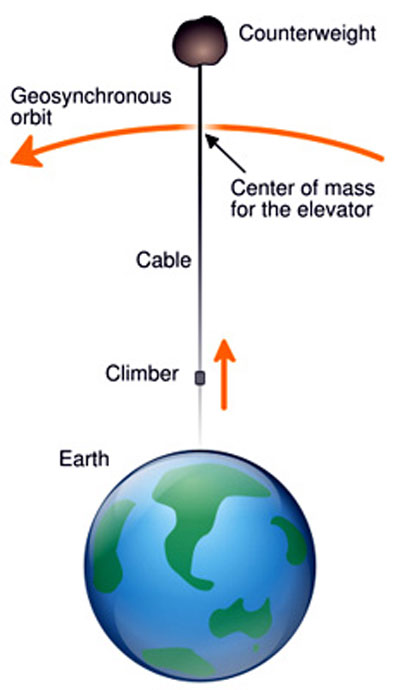
In 2002 I came up with a genius idea of an easier way to get people into space. A lift, that would climb up a really strong cable to a geo-stationary satellite. Then once they're up there, they people can get into their spaceships that are conveniently parked in orbit. Thus saving on all that oh-so-expensive rocket fuel. Oh how my colleagues laughed.
But then, around 2 years later I read in the Metro that this was exactly what scientists were working on. Had NASA stolen my idea? ....well no. A quick shufty on wikipedia tells me that the idea had been around for over 100 years.
Great minds, eh? This has to be my first proven genius idea. (and it surely is a genius idea - NASA's spent millions on the research already).
The 22-year-old me was so smart. I remember that day, I was on a roll. Later that afternoon I also came up with...
The Lunar Aqua-Park!
I also told my colleagues about this one. Genius it is... and before I explain it to you, please bear in mind that this can be done, but only in the far distant future... and by a company/person with extreme wealth and little consideration for the future of life on our planet.
The concept is a simple one: A water park on the moon. Can you imagine it? ...You'd have loads of water slides, shoots and swimming pools. All housed in some giant geodesic domes. It'd be like CentreParks in space. But of course, the difference being there is much less gravity on the moon. It'd be awesome.
Now here's the genius bit. ('What Jon? Was that not the genius bit already.... the general concept?' .... Well yeah, but it gets better.) One of the attractions in this park is a ride that tunnels through the ground right through to the centre of the moon ...and there would be a giant cavern carved out, and about 4 swimming pools worth of water dumped in there. The water would all float like a liquid sphere in the centre of the moon and people would dive in from all angles. I call it The Lunaquasphere™. How cool would that be in the centre?... swimming about with every direction being up. And also, because there's less gravity, you could dive in from much higher and not hurt yourself. Brilliant eh? ... Nothing can go wrong. Although, like I say, I've not really looked into the earthly repercussions of having a big hole into the centre of the Moon. If the Moon lost some of it's mass, it may actually affect the Earth's tidal patterns, seasons, the Moon's orbit round the Earth, and possibly even the Earth's orbit around the sun. It would certainly jeopardise the future of life on Earth... Still, imagine all the fun you could have in a Lunaquasphere™.
 |
| Possibly not to scale. |
But then, around 2 years later I read in the Metro that this was exactly what scientists were working on. Had NASA stolen my idea? ....well no. A quick shufty on wikipedia tells me that the idea had been around for over 100 years.
Great minds, eh? This has to be my first proven genius idea. (and it surely is a genius idea - NASA's spent millions on the research already).
The 22-year-old me was so smart. I remember that day, I was on a roll. Later that afternoon I also came up with...
The Lunar Aqua-Park!
I also told my colleagues about this one. Genius it is... and before I explain it to you, please bear in mind that this can be done, but only in the far distant future... and by a company/person with extreme wealth and little consideration for the future of life on our planet.
The concept is a simple one: A water park on the moon. Can you imagine it? ...You'd have loads of water slides, shoots and swimming pools. All housed in some giant geodesic domes. It'd be like CentreParks in space. But of course, the difference being there is much less gravity on the moon. It'd be awesome.
Now here's the genius bit. ('What Jon? Was that not the genius bit already.... the general concept?' .... Well yeah, but it gets better.) One of the attractions in this park is a ride that tunnels through the ground right through to the centre of the moon ...and there would be a giant cavern carved out, and about 4 swimming pools worth of water dumped in there. The water would all float like a liquid sphere in the centre of the moon and people would dive in from all angles. I call it The Lunaquasphere™. How cool would that be in the centre?... swimming about with every direction being up. And also, because there's less gravity, you could dive in from much higher and not hurt yourself. Brilliant eh? ... Nothing can go wrong. Although, like I say, I've not really looked into the earthly repercussions of having a big hole into the centre of the Moon. If the Moon lost some of it's mass, it may actually affect the Earth's tidal patterns, seasons, the Moon's orbit round the Earth, and possibly even the Earth's orbit around the sun. It would certainly jeopardise the future of life on Earth... Still, imagine all the fun you could have in a Lunaquasphere™.
Subscribe to:
Posts (Atom)