Whilst we're taking about what scientists don't know, dark energy isn't the only bollocks phrase they've invented to explain things they don't know. The other one is dark matter (not to be idiotically confused with anti-matter). This was invented to explain away the reason why they can't account for the massive lack of mass in the universe.
Again the answer is obvious. All the mass in the viewable universe only accounts for about 4% of all the mass there should be. The remaining 96% lies in the areas of space we can't see, because they exist more than 13.7 billion lightyears away. Cosmologists think this is wrong because they've misjudged the current size of the universe, by assuming that they know it's current speed. Mystery solved.
It just goes to show, if you make an ill-informed, half thought out assumption in one instance, it'll have a logical knock on effect for all the rest of your reasoning. Obviously all of my scientific arguments are flawless and impeccable, so there's absolutely no reason to even doubt their credibility. All have been scientifically peer reviewed by the equally genius and sound mind of my assistant Ziggy, the invisible time-travelling hamster.

Showing posts with label Space. Show all posts
Showing posts with label Space. Show all posts
13 September 2013

11 September 2013
The State of the Universe (aka Gravity Part V)
There's a fairly large question about the universe that cosmologists have been unable to definitively answer, and that's 'Why does the universe look like it does?'. An amazingly simple question, I think you'll agree, and it doesn't take a genius to come up with an amazingly simple answer to this question... or perhaps it does.
In the likely event that you're in the dark as to what the universe looks like, let me enlighten you. This universe (for it is probable that there are many) is comprised of a few hundred billion galaxies. These galaxies are not scattered completely randomly, but are instead spread out in a three dimensional stringy web-like pattern. A good analogy that has been made for this is a load of washing-up bubbles, where the washing-up liquid that makes up the bubbles themselves represent the galaxies, and the air within the bubbles represents the vast gaps of nothing in the universe.

Theoretical physicists have the problem that they don't know how the universe got into this state. Well, it seems pretty obvious to me. I mean, I'm no astrophysicist, but it's hardly rocket science: The galaxies remain in a stretched out web pattern because matter naturally distorts space-time, which has an instantaneous effect on the propagation of any and all matter relative to both the distance and the combined mass of any and all of the masses within the system. The net effect of all of this intergalactic mass is a sort of mass intergalactic net effect, and the appearance of the universe as it has been observed fits in exactly as predicted by the above model.
You probably realised that this is a description of gravity, but I really wanted to explain what is happening without confusing matters... and people seem to get confused whenever someone mentions the G-word. They think it's a force or something! ...the idiots.
So what's the prob?
The cosmic boffins still have the issue of explaining why the universe is still expanding, when gravity should've started making it contract by now. They've attributed this to Dark Energy [cue mystical/scary music].
Dark energy is just a phrase they've invented, because they can't think of they're own explanation that doesn't involve magic, witchcraft, god or anything else made up.
It all seems quite self-evident to this genius: The universe is still expanding because the explosion that created this universe was bloody massive. You can't even begin to imagine how big it was. Sure, the effect of gravity has slowed the expansion substantially since the universe began, but that's small beans compared to how fast it was originally going at 13.7 billion years ago. Back then it was all relatively pretty close to the cosmic speed limit. So of course gravity hasn't put the breaks on fully. If/when that eventually happens, our universe will start to contract slowly. But then as time goes on, the speed of contraction will continue to accelerate... to the point that it will eventually reach a point (by which I mean a singularity) just at the point when the relative speed reaches the cosmic speed limit of the universe.

In the likely event that you're in the dark as to what the universe looks like, let me enlighten you. This universe (for it is probable that there are many) is comprised of a few hundred billion galaxies. These galaxies are not scattered completely randomly, but are instead spread out in a three dimensional stringy web-like pattern. A good analogy that has been made for this is a load of washing-up bubbles, where the washing-up liquid that makes up the bubbles themselves represent the galaxies, and the air within the bubbles represents the vast gaps of nothing in the universe.

Theoretical physicists have the problem that they don't know how the universe got into this state. Well, it seems pretty obvious to me. I mean, I'm no astrophysicist, but it's hardly rocket science: The galaxies remain in a stretched out web pattern because matter naturally distorts space-time, which has an instantaneous effect on the propagation of any and all matter relative to both the distance and the combined mass of any and all of the masses within the system. The net effect of all of this intergalactic mass is a sort of mass intergalactic net effect, and the appearance of the universe as it has been observed fits in exactly as predicted by the above model.
You probably realised that this is a description of gravity, but I really wanted to explain what is happening without confusing matters... and people seem to get confused whenever someone mentions the G-word. They think it's a force or something! ...the idiots.
So what's the prob?
The cosmic boffins still have the issue of explaining why the universe is still expanding, when gravity should've started making it contract by now. They've attributed this to Dark Energy [cue mystical/scary music].
Dark energy is just a phrase they've invented, because they can't think of they're own explanation that doesn't involve magic, witchcraft, god or anything else made up.

11 June 2013
Science Friction (Perpetual Motion's Nemesis)
These days I seem to be posting my ideas more infrequently. Which is to say, I've been posting my ideas more sparsely, with a higher rate of infrequency, and in fewer abundance. Which is to say, in plain English, I've been posting less inperiodically or more commonly less frequently more often.
It is for this reason that I challenged my genius brain to come up with an idea that will solve more than one of mankind's problems in one go. We're talking killing two birds with one stone. But I didn't want to stop at two. Anyone who knows me knows how I love to maim a multitude of feathered creatures with one projectile, but on this occasion I decided to leave them be, and just think about the problem I'd set myself. Well within 15 minutes I came up with a single concept that will help reduce humanity's social, environmental, technological, residential and economic problems. All you need is a few decades work on an international scale, in a large section of Antarctica.
(an area of 500km radius around the south pole to be exact)

Problem 1.
The prisons in [insert country here] are full, but people keep doing crimes.
Solution: Send all the world's prisoners (or all the lifers at least) to one massive prison on an island. Perhaps not such an original idea. It's like when the US used to send criminals to Alcatraz. ...or when the UK used to send criminals to Australia. (In retrospect we call all agree that the latter was a terrible idea).
A large prison will be built in the centre of the continent of Antarctica, which (when the prisoners have finished building it) will be escape-proof. Anyone leaving the prison complex to go outside is essentially committing suicide. This of course is illegal, and will be punished by 24 hours isolation in the cooler.
Once it's up and running, a vast majority of the worlds prisons can be closed. ... and then converted into budget housing. I'm not suggesting people will live in cell-sized flats. (not everyone anyway) I'm saying you could knock though several cells and have an apartment that was made up of up to 5 cells. Luxury.
Problem 2.
How can the world save money on the space program?
Solution: You'd have a lift into space. Yes, this isn't a new idea, not even by me. But it is an idea I came up with many years ago. I've adapted it though, so that the base of the lift is in the Antarctic (to capitalise on the very cheap/free labour among the local residents), and the counterweight at the other end is in a low orbit in space, but at an angle (of maybe 60°) from the base. The counterweight can make several orbits of the Earth each day in the opposite direction that the Earth is turning. The base in this new design however is actually anchored to a platform that moves around a large track with a circumference of approximately 3142km around the South Pole (again, built over many years by convicts). The speed of the platform around the track can be altered any time the lift needs to be used. Why the track? Well this is part of the answer to my third problem...
Problem 3.
How can we create renewable energy and stop burning fossil fuels?
Solution: This is also a question I've attempted to answer before. Albeit, not very convincingly. The idea was a very simple perpetual motion machine. And while that genius magnetic contraption has it's charms, I'll be the first to admit that it does sort of contravene Newton's third law of motion. Generally you can't create energy from nothing. You can only convert energy. Which is exactly what we're doing here. For all intents and purposes, this coasting Antarctic space elevator is a genuine perpetual motion machine. It would actually work. Why? Because it's not actually a genuine perpetual motion machine. But it almost is. The movement on the track will either turn a giant underground wheel, or turn a series of generator as the platform speeds round the track. The speed of the thing is determined by the radius of the track as well as the height of the counterweight's orbit.* It will never stop, so long as the Earth keeps spinning. A by-product of this ingenious suggestion is that (very gradually) the Earth's spin will slow down as a result of friction. The Earth's spin is slowing down very gradually anyway, but this machinery will increase this deceleration. However, it's worth pointing out that you won't see any noticeable effect of this for many hundreds of years. ...probably.
Still, I'm always saying there aren't enough hours in the day.
*Assuming the counterweight goes round the earth just twice a day, and the track has a diameter of 1000km, then the base will be travelling at about 262km/h (163mph). For convenience this speed can be sped up or slowed down by decreasing or increasing the length of the counterweight's tether.
It is for this reason that I challenged my genius brain to come up with an idea that will solve more than one of mankind's problems in one go. We're talking killing two birds with one stone. But I didn't want to stop at two. Anyone who knows me knows how I love to maim a multitude of feathered creatures with one projectile, but on this occasion I decided to leave them be, and just think about the problem I'd set myself. Well within 15 minutes I came up with a single concept that will help reduce humanity's social, environmental, technological, residential and economic problems. All you need is a few decades work on an international scale, in a large section of Antarctica.
(an area of 500km radius around the south pole to be exact)

Problem 1.
The prisons in [insert country here] are full, but people keep doing crimes.
Solution: Send all the world's prisoners (or all the lifers at least) to one massive prison on an island. Perhaps not such an original idea. It's like when the US used to send criminals to Alcatraz. ...or when the UK used to send criminals to Australia. (In retrospect we call all agree that the latter was a terrible idea).
A large prison will be built in the centre of the continent of Antarctica, which (when the prisoners have finished building it) will be escape-proof. Anyone leaving the prison complex to go outside is essentially committing suicide. This of course is illegal, and will be punished by 24 hours isolation in the cooler.
Once it's up and running, a vast majority of the worlds prisons can be closed. ... and then converted into budget housing. I'm not suggesting people will live in cell-sized flats. (not everyone anyway) I'm saying you could knock though several cells and have an apartment that was made up of up to 5 cells. Luxury.
Problem 2.
How can the world save money on the space program?
Solution: You'd have a lift into space. Yes, this isn't a new idea, not even by me. But it is an idea I came up with many years ago. I've adapted it though, so that the base of the lift is in the Antarctic (to capitalise on the very cheap/free labour among the local residents), and the counterweight at the other end is in a low orbit in space, but at an angle (of maybe 60°) from the base. The counterweight can make several orbits of the Earth each day in the opposite direction that the Earth is turning. The base in this new design however is actually anchored to a platform that moves around a large track with a circumference of approximately 3142km around the South Pole (again, built over many years by convicts). The speed of the platform around the track can be altered any time the lift needs to be used. Why the track? Well this is part of the answer to my third problem...
Problem 3.
How can we create renewable energy and stop burning fossil fuels?
Solution: This is also a question I've attempted to answer before. Albeit, not very convincingly. The idea was a very simple perpetual motion machine. And while that genius magnetic contraption has it's charms, I'll be the first to admit that it does sort of contravene Newton's third law of motion. Generally you can't create energy from nothing. You can only convert energy. Which is exactly what we're doing here. For all intents and purposes, this coasting Antarctic space elevator is a genuine perpetual motion machine. It would actually work. Why? Because it's not actually a genuine perpetual motion machine. But it almost is. The movement on the track will either turn a giant underground wheel, or turn a series of generator as the platform speeds round the track. The speed of the thing is determined by the radius of the track as well as the height of the counterweight's orbit.* It will never stop, so long as the Earth keeps spinning. A by-product of this ingenious suggestion is that (very gradually) the Earth's spin will slow down as a result of friction. The Earth's spin is slowing down very gradually anyway, but this machinery will increase this deceleration. However, it's worth pointing out that you won't see any noticeable effect of this for many hundreds of years. ...probably.
Still, I'm always saying there aren't enough hours in the day.
*Assuming the counterweight goes round the earth just twice a day, and the track has a diameter of 1000km, then the base will be travelling at about 262km/h (163mph). For convenience this speed can be sped up or slowed down by decreasing or increasing the length of the counterweight's tether.
03 March 2013
The Speed of the Universe
"People often ask me about the universe..." says the daft-punk speak'n'spell robot voice controlled by supposed genius Professor Stephen Hawkings. Well people would ask him wouldn't they. But then people are stupid. Believe me I've met a few.
Today (and over the next few days/weeks) I'm going to tell you about the universe... (yes, I am aware you never asked). I'm going tell it how it really is and point out where current science has got it wrong.
First up, the speed of the universe.

It is currently trendy in cosmological circles to believe that the universe is expanding. Not only that, but expanding at an accelerating rate too.
This is nonsense.
The universe is not accelerating. It is definitely decelerating. Not only that but it's possible it could have come close to stopping expanding all together. You want proof? ... Gravity.
The effect of gravity generally makes matter attract other matter. This is why the universe is and always has been slowing down. If the effect of gravitation didn't exist, the universe still wouldn't be accelerating. It would just keep expanding at the same speed. That's Newton's first law right there; the law of inertia.
So what we have is an expanding universe that is not naturally inclined to speed up, even before we include gravity. Once we add effect of gravity to this universe as well as the resulting effect of friction, we have a universe that is definitely slowing down. As a result of gravity and friction in our universe, matter (particularly solid matter) generally doesn't like to be stretched.
Ahhh, you say, but what about the red spectrum shift that proves that all galaxies are spreading out and that the ones furthest away are getting further away faster?
You're not thinking fourth dimensionally!(as the creator of time travel will famously say). I agree those farthest galaxies are expanding toward the outer universe and they are expanding at a faster rate than the nearer galaxies. But you forget, those galaxies at the edge of the viewable universe are 13.7 billion light-years away. We're looking at that area of space the way it was 13.7 billion years ago. It's has taken that long for their light to reach us.
Now lets look at a relatively close neighbouring galaxy, Andromeda. It's only 2.5 million light-years away. Like all galaxies, it is getting further from us, but not at nearly the same rate as those at the edge of the viewable universe. When we view Andromeda, we're seeing it as it was just 2.5 million years ago.
Let's look at those (very approximate) figures again...
Edge of the observable universe as seen: 13,700,000,000 years ago.
The Andromeda galaxy as seen: 2,500,000 years ago.
So in conclusion, things were flying about much faster a long long time ago, and things are flying about a lot more slowly more recently. Therefore:
The expansion of the universe is slowing. Q.E.D.
Ha! In your face, Hawkings!
Also I should add that my claim that the universe has now almost come to a stop is based upon the the above fact, the known age of the universe, and the known effects of gravity.
I postulate that at this very moment, at the actual edge of the universe (that we cannot see), the current speed of those galaxies will not be much faster than the relative speeds of the nearby galaxies in the local vicinity.
Can someone get Professor Brian Cox on the phone, I have some news for him.
04 March 2012
Gravity Part IV: The Afterthought (It's All Relative)
Gravity! What is it good for?!... Absolutely nothin'! -Say it again!
Gravity! -Oh wait... no. That's 'war' I was thinking of. Yeah. No, thinking about it, gravity's actually quite useful.
So I really didn't want to have to explain this any further, what with having explained gravity away on three different levels:
And thus far you can take all the above as absolutely true, and non of it contradicts it's self. No.... Not at all. Not really. Each one is a deeper understanding of the basic principle. (Although on the face of it, Part one kind of looks like a load of bollocks, but that's not to say it definitely isn't true, and you can't prove otherwise!)
Well this section (that i imaginatively call 'Part Four' )will give the most basic underlying reason why the gravity effect happens. It is the most basic, and beautifully simplistic cause of the 'force' that we call gravity. And it only occurred to me last week:
Gravity is an effect that happens to objects because all objects in space are falling.
This may seem like a circular argument for you may think that you cannot use the effect of gravity to explain the effect of gravity. But when I say 'falling' I mean travelling in space in whatever way/direction it happens to be travelling. All objects do this. It's the law of inertia; An object will never change it's speed or direction unless it is acted upon by another object/force. So all objects are constantly falling through space... constantly.
You still with me?
Ok, so the reason these objects' trajectories are affected by other objects is all about the law of inertia. Without anything affecting it, a planet will always stay constant. ie. it will not change direction, and (if it is moving) it will not accelerate or decelerate.
Although to say it won't accelerate or decelerate is wrong... as there is no such thing as absolute space or indeed absolute speed: If one planet goes past another there is no way to say which planet is moving or which planet is static. You can't say at what speed anything is ultimately travelling at.
At this moment, you may be sat still. ...but are you really? What if you where sat on a train, you maybe travelling at 100mph. ...and the old lady walking up the train towards the buffet carriage might be moving faster (at 102mph?).
Even if you're not on a train, the earth is spinning which means you could be moving at about 1000mph. But this is just the speed you move on a daily basis, the earth spins (relative to the sun). What about the earth's orbit of the sun? You're actual travelling at a rough average of 66500mph. Except that's still only relative. You're often actually going faster than that, as the sun is travelling at immense speed around our galaxy. But then that is still only relative to the centre of our galaxy and the positions of the other galaxies. What about the speed at which all galaxies are travelling away from one another? That speed in itself is relative as we have no other point of reference. It is an assumption that galaxies are move at the same speed and this way we can backtrack and figure out the point in the universe where it all began. ...relative to our universe. I believe we're part of an omni-verse full of universes so far away that they're not nearly old enough for the light from their origin to even reach the outer edges of our universe. These other universes will no doubt be travelling at their own speed relative to our own in whatever direction, and again there's no way to determine how fast (if at all) each universe is travelling...
But I digress...
The idea behind my statement 'all objects in space are falling' is that the object don't deviate from their course. In fact relatively speaking, they don't necessarily have a course... or a speed. If you want to believe that you are the centre of the universe (as I do), then that's fine as there is no such thing as absolute space. Only relative space and relative motion exists. This ties in to the law of inertia. Objects keep their same relative position in space, and they keep their same relative speed that they're relatively moving at. ... relatively.
It's like water will always flow in the path of least resistance. Or to use an analogy that is unrelated to gravity: Light will travel in the path of least resistance, ie. the shortest route to it's destination. It's true that light goes in every direction, but if you were to obscure star a from direct view with a planet in the way, the light from the star can still bend around the planet to reach you. But obviously this only works to a certain point. If photons from a source can reach a destination, then they will have got there via the easiest route possible.
So... we're on a planet falling through the universe at an incredible relative speed to the rest of the universe. Luckily this speed is relatively diminished greatly by 1) being drawn to the large mass that is our sun, and thus making us seem relatively slower on a local level... and 2) our solar system is made relatively slower by moving approximately the same speed as lots of other solar systems that surround us in this spiralling whirlpool-like collection of solar-systems that we call the Milky Way.
This is what Gravity is. In actual fact, the universe isn't going at any great speed. There is just the relative differences from one thing to another. Mass affects and attracts other masses to a certain extent. But more so for masses that are travelling at a similar speed and/or in closer proximity. We don't float away when stood on the earth because of the size and proximity of the planet. It is our 'path of least resistance'. Even if we could float up in the air (and imagine if we were the size of an oxygen molecule for this) we wouldn't get beyond the stratosphere because we have a mass and still need to 'fall' in the path of least resistance. Such a path does not include leaving our atmosphere to go out into space that is relatively moving (it's not actually moving) a hell of a lot faster than we are. It'd be like joining a busy motorway via a T junction when everyone's going at 70mph in the slow lane, and you're driving a milk-float.
In short, a planet revolves around a sun because it does: It's either always been there, or has entered the sun's vicinity, and didn't have enough energy to continue it's original trajectory back into relatively-different-speed space. It would have altered it's course accordingly. Like if there was a fly in your car, and you're driving at 70mph. The fly isn't flying at 70mph. Then you open the window and if the fly leaves it doesn't continue at the same speed as the car. (though it probably goes a bit faster than it would normally fly in that direction for a short time).
To sum up...
You can call gravity a force if you want... but what is any force but an affect of some other phenomena? In this case it is caused by the relative difference between the speed you're travelling at, and the relative speed of your nearest local moon/planet/solar-system/galaxy/universe.*
*delete as appropriate.
28 July 2011
Gravity Part III: The End (The Life of the Universe ...and Everything)
The universe is an interesting place. I should know, I've lived in it most of my life. But how did it get here? Will it be here forever? And if not, what happens when it dies?
Various theories have been bandied about on the subject of the universe's longevity. It seems that the scientific community's jury is still out on these matters, so I think it only right for a probable genius such as myself to illuminate the truest most probable scenario.
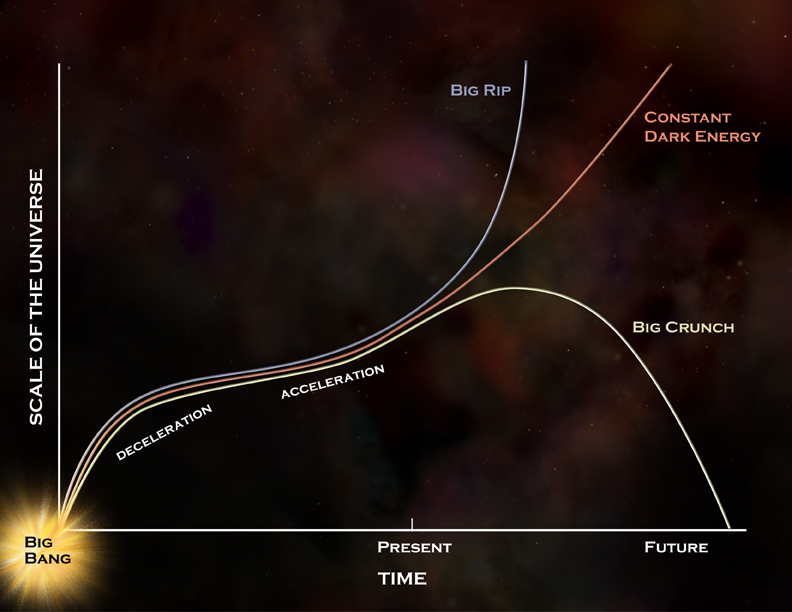 |
| Current scientific speculation about the universe. All wrong for the most part. |
Gravity is the key to the end of time. Of the current opinions, the most common ones suggest that either all mass in our universe will stop accelerating away from each other and then gravity will make it fall back on itself (The Big Crunch) ...or all the galaxies in the universe will continue to get further and further away from one-another, in which case after a stupidly long period of time, entropy will set in, everything will cool down and break up into their component atoms until they simply disappear. And the end of matter in the universe means the end of time itself. It is believed that this second scenario is the more likely of the two, because there currently isn't enough known matter in the universe for the first scenario to happen. Well I'm here to tell you that both of these scenarios are wrong...
...sort of.
It is my (unquestionably correct) opinion that the universe is infinite. That is to say that it's always been here. There is no start and there is no end. But there are cycles of similar (but not identical) repetition within. Time and space in the universe are not constant. They are infinite, however I will concede that it is acceptable to call them finite as time and space can only be measured in relation to something else. They are concepts that are relative to the observer and it is impossible to view the space-time continuum in a non-objective way. When I refer to the universe then, I am of course referring to everything and not perhaps 'the universe' as you would understand it.
Perhaps I should redefine this term. It is my belief that the universe as we know it is in fact just a small part of a wider universe. A multiverse or omniverse if you will. I will opt to call it the latter as multiverse suggests that the whole thing is just made up of multiple universes, but it's a bit more complex than that. Omniverse seems the right word to me at it means 'all', and in this case we truly mean all.
To begin with I reasoned the following idea to be a plausible model for an infinite omniverse:
All the galaxies in our universe are getting further away from each other... As there isn't enough matter to pull it all back together (because antimatter is probably responsible long ago for the annihilation of a great number of galaxies in our universe, hence the gaps. See Gravity Part II for more details on this phenomenon.), all the galaxies will spread out and disintegrate as mentioned in the 2nd scenario above. Eventually after what can be described as a literal eternity, all that's left of these vastly sparse galaxies is an innumerable number of basic component atoms. But this is where gravity comes back in, because even in an infinite universe with a finite number of atoms,... given a long enough time period (and we're talking an infinite time period here), all it takes is two of these atoms to collide in order to attract further atoms from across the endless cosmos. I should remind you that matter has a gravitation affect on all other matter in the universe, no matter the matter of the distance from the matter. It may sound fairly unlikely, but even if the effect of gravity didn't exist, so long as the atoms are moving and given an infinite amount of time these atoms will find each other... every time. So this is how new universes are born from dead universes. And that cycle goes on and on forever.
So, are you with me so far? Did you understand the basic principle laid out in the last paragraph. Okay, now I'd like you to forget about all of that, because as I said, the above was just my initial reasoning and I'd like you to see some of the workings of a genius mind such as my own. The true nature of the universe is so much more beautiful than that. It is far more complex, and yet it is a simpler solution at the same time. Allow me to explain in such terms that even a non-genius (such as yourself) can understand:...
My ultimate theory on the infinite universe states that there is only one universe. There are however an infinite number of universes that exist in a reality of there own. I call this a dimension-straddling omniverse. The basic model goes along with current scientifically known fact; there is a big bang, the universe is created, and then there's some time.... and 'some time' later the universe dies. The End.
Except it is not the end. It doesn't answer the question of what caused the big bang in the first place. It ultimately has to do with gravity. When a sun goes supernova and collapses in on itself it become a black hole. These black holes create new universes within the 5th dimension. The term 'black hole' is perhaps a bad description for the phenomena. It may appear black (because light cannot escape it's gravity) but it is not a hole. It is a singularity that sucks in matter, light and time. Effectively it's a pinched section of space-time.
It may help you to imagine this on a 2D plane rather than the 3D plane we're used to. If space-time is represented by a tablecloth then a black hole would be represented by the effect that a vacuum cleaner would have when applied to that tablecloth. The hoover bag in this analogy represents a new universe. But this cosmic carpet cleaner is not within the 2D universe we know, it exists within an extra dimension.
 |
| The 3D black-hole effect on a 2D universe. |
It may help you to imagine this on a 2D plane rather than the 3D plane we're used to. If space-time is represented by a tablecloth then a black hole would be represented by the effect that a vacuum cleaner would have when applied to that tablecloth. The hoover bag in this analogy represents a new universe. But this cosmic carpet cleaner is not within the 2D universe we know, it exists within an extra dimension.
Now lets add a couple of dimensions to the above tablecloth/hoover scenario. We have the 4 dimensional universe of space-time that we know and love, and then we have the 5 dimensional omniverse that consists of numerous 4D universes.
This all ties in neatly with my theory that gravity itself is caused by gaps in space-time displacing the continuum, as stated in Gravity Part I.
So, ... every black hole in our universe will create another universe. And our universe was created by the black hole phenomena of another universe. Although our universe is massive, it is also finite, and so every universe will create a finite number of universes. How many? ...depends on how many black-holes are created in a universe.
 |
| This* is not a literal representation of the omniverse. |
All the above is fact. Some of these facts may yet to be proven as 'facts', but that's for the scientific community to get it's head around. I don't have the time to wait for these supposed experts to catch up. Nor do I possess the time or resources to devote my life to such a simple (and obvious) cause as the nature of the omniverse. But take my word for it, this is the way it is. Fact.
Oh and for all the people with faith who believe that God created the universe: Some of you might want to embrace this new wisdom of mine, and try and explain that this scenario still fits with in your beliefs; that each universe is indeed created by an unknown higher power, that the vacuum cleaner in my earlier analogy is in fact God Himself, constantly creating universes from the remnants of previous universes, and technically being 'omni-present' within the 5 dimensional omniverse.... Well it isn't. It's not him. He doesn't exist. Get over it!
* Just some nice art work (admittedly pilfered from someone else's site) which nicely illustrates the infinite and procreative nature of the omniverse. It obviously doesn't look like that. The universes aren't even sharing the first four dimensions. Don't take it literally.
Oh and for all the people with faith who believe that God created the universe: Some of you might want to embrace this new wisdom of mine, and try and explain that this scenario still fits with in your beliefs; that each universe is indeed created by an unknown higher power, that the vacuum cleaner in my earlier analogy is in fact God Himself, constantly creating universes from the remnants of previous universes, and technically being 'omni-present' within the 5 dimensional omniverse.... Well it isn't. It's not him. He doesn't exist. Get over it!
* Just some nice art work (admittedly pilfered from someone else's site) which nicely illustrates the infinite and procreative nature of the omniverse. It obviously doesn't look like that. The universes aren't even sharing the first four dimensions. Don't take it literally.
27 January 2011
Gravity Part II: The Sequel (A Life and Death of Matter)
So I thought up this theory whilst reading up on antimatter. Incidentally... I still think my gravity (part I) theory is still excellent and valid, but in the very unlikely event that I may be wrong on this, what follows is an equally well thought out and plausible (& even probable) reason for why matter is attracted to other matter.
I'll keep this brief and to the point so you can understand it (We can't all be geniuses* like me).
My theory simplified goes like this: Matter is actually only attracted to Antimatter. Matter is unnatural and chaotic. The universe wants to revert back to it's original state of no-matter.... and so all matter gets sucked into antimatter.
A quick lesson on antimatter:
Matter exists in the universe. Antimatter also exists. This explains where that matter came from. You don't get owt for nowt, and you can't get a universe containing matter, without creating an equal amount of antimatter. Matter comes into being and is then destroyed with the separation and then amalgamation of matter and antimatter. The current problem for scientist is this:.... they haven't found nearly enough antimatter in the universe to account for all the matter.
************************************
************************************
******** INTERMISSION ********
************************************
************************************
Welcome back to Gravity Part II.
My theory concerning why matter is attracted to matter... The simple answer is: It's not! It's attracted to antimatter. Yep, that's my theory.... That inside every sun, planet or moon is some antimatter that sucks in all matter around it. This explains the whereabouts of all the antimatter that physicists are looking for in the universe, and it also fairly simply explains why all large masses have gravity.
Most of a planet's mass will be regular matter, but some small fraction of it in the centre will be made of antimatter. The antimatter will be a lot smaller in size and therefore much denser. So... if the Earth and the Sun and every heavenly body has antimatter at it's heart, then why doesn't everything just disappear?... Well that's all down to the fact that everything is spinning. It's the centrifugal force that makes all matter want to escape from the antimatter that would otherwise affect it. Even in supposed zero gravity, if you spin a bucket of water around fast enough, the water should stay in the bucket. (Law of inertia: Things'll keep moving in the same direction at the same speed unless there's some other force to make it slow down or make it change direction).
So it's the same throughout the universe. The Earth spins. It's matter is kept from destroying it's self thanks to it spinning. Just like the planets going round the sun. If the planets were static, the sun's gravitational pull (thanks to the mass of antimatter at it's core) would suck every planet into it. The sun (and our entire solar system) is travelling round the whirlpool that is our galaxy The Milky Way. At the heart of the Milky Way is a very large dense amount of antimatter (this is basically what a black hole is) and this sucks much of the surrounding matter in. As the milky way is spinning I'm uncertain as to whether all it's matter will eventual come into contact with this antimatter, but it depends on how fast it's spinning.
Finally every galaxy has it's own place in the universe. Scientists have been able to map the whereabouts of many galaxies and a pattern has emerged. The galaxies form a kind of random stringed web pattern with great big gaps in between, but know one has known why these gaps are there. I can now reveal that these massive gaps of nothingness in the universe are where there used to be galaxies, but galaxies where matter and antimatter have returned to one-another. Perhaps they weren't spinning fast enough to survive, or perhaps there happened to be more antimatter than matter (in which case maybe other galaxies have more matter than antimatter to make up for the imbalance). Or maybe they were the oldest galaxies and they had just run their course, indicating that perhaps all galaxies are destined for this fate of nothingness.
Now once again, I'll remind you that I'm no astral-physicist, and at the moment, these ideas are just ideas. But they do answer several unanswered mysteries. Perhaps the science community need a possible genius like me to point it in the right direction. I'm not saying I'm definitely right**... but I'd like to see some conclusive proof that I'm definitely wrong before someone brands Jonisnotagenius NOT a genius.
* Or should that be genii?
** Let's be honest, I probably am.
19 November 2010
The Space Telescopic Time Mirror!
Yes. That's what NASA should do.... send out a big unmanned space probe with a big mirror on it. Why?... so we can look at ourselves.... in the past!
Immediately I will say that I don't know for sure that someone isn't already doing this genius idea, as it seems quite an obvious one to me. But perhaps my idea is unique for the possible future applications a big space mirror would have.
I believe there are already space probes and space telescopes that are on a mission into to leave our solar system and head out into deep space. These send back more detailed pictures of the universe than we would get from out planet.
My proposal is such a space probe that will not only be able to transmit pictures from afar, but also have a telescope pointed back at the earth, with an incredible amount of detail. This amplified image will be reflected back in our direction by a giant space mirror on the craft. It needs to be pretty big because of the vast distance it will travel, so we can see it from earth.
Now here's the clever application. If the space craft/mirror goes far enough we will eventually be able to see back in time! It'll take a few decades (probably) but the accuracy of telescopic technology on earth should be able to keep up with the distance the craft will travel. The further from our solar system it gets the further back in time we will see the earth. ...to the point that we will be able to see past events from a certain amount of time ago.
Initially this could be used to solve crimes, maybe by pinpointing an individual's position at a certain time on a certain day. Eventually... (and maybe we're talking hundreds of years time) we'll be able to use this technology for historical research.
For every light-year the craft travels away from us, we will be able to see 2 light years into our past... as the light from earth has to travel to the telescope and back to the earth again.
And obviously it'll have duel use, it can also be used to view deep space. (when it's not solving Columbo style mysteries)
How will it be powered? ... Initially, solar power. There should be enough power as it passes our sun to get up to a pretty amazing speed. ...Then so long as it doesn't crash into a planet or moon, it will keep going at this speed forever. Laws of inertia state that if nothing's there to slow it down, it'll just keep going. With our next nearest star just over 4.2 light-years away, it won't be long before any loss in speed is regained. Nothing can go wrong.
Immediately I will say that I don't know for sure that someone isn't already doing this genius idea, as it seems quite an obvious one to me. But perhaps my idea is unique for the possible future applications a big space mirror would have.
I believe there are already space probes and space telescopes that are on a mission into to leave our solar system and head out into deep space. These send back more detailed pictures of the universe than we would get from out planet.
My proposal is such a space probe that will not only be able to transmit pictures from afar, but also have a telescope pointed back at the earth, with an incredible amount of detail. This amplified image will be reflected back in our direction by a giant space mirror on the craft. It needs to be pretty big because of the vast distance it will travel, so we can see it from earth.
Now here's the clever application. If the space craft/mirror goes far enough we will eventually be able to see back in time! It'll take a few decades (probably) but the accuracy of telescopic technology on earth should be able to keep up with the distance the craft will travel. The further from our solar system it gets the further back in time we will see the earth. ...to the point that we will be able to see past events from a certain amount of time ago.
Initially this could be used to solve crimes, maybe by pinpointing an individual's position at a certain time on a certain day. Eventually... (and maybe we're talking hundreds of years time) we'll be able to use this technology for historical research.
For every light-year the craft travels away from us, we will be able to see 2 light years into our past... as the light from earth has to travel to the telescope and back to the earth again.
And obviously it'll have duel use, it can also be used to view deep space. (when it's not solving Columbo style mysteries)
How will it be powered? ... Initially, solar power. There should be enough power as it passes our sun to get up to a pretty amazing speed. ...Then so long as it doesn't crash into a planet or moon, it will keep going at this speed forever. Laws of inertia state that if nothing's there to slow it down, it'll just keep going. With our next nearest star just over 4.2 light-years away, it won't be long before any loss in speed is regained. Nothing can go wrong.
30 October 2010
The Space Lift & Lunar Aqua Park!
Here's a couple of genius ideas I had at the same time. They're a good example of ideas that might sit at either end of the actual genius spectrum.
A Lift Into Space!
In 2002 I came up with a genius idea of an easier way to get people into space. A lift, that would climb up a really strong cable to a geo-stationary satellite. Then once they're up there, they people can get into their spaceships that are conveniently parked in orbit. Thus saving on all that oh-so-expensive rocket fuel. Oh how my colleagues laughed.
But then, around 2 years later I read in the Metro that this was exactly what scientists were working on. Had NASA stolen my idea? ....well no. A quick shufty on wikipedia tells me that the idea had been around for over 100 years.
Great minds, eh? This has to be my first proven genius idea. (and it surely is a genius idea - NASA's spent millions on the research already).
The 22-year-old me was so smart. I remember that day, I was on a roll. Later that afternoon I also came up with...
The Lunar Aqua-Park!
I also told my colleagues about this one. Genius it is... and before I explain it to you, please bear in mind that this can be done, but only in the far distant future... and by a company/person with extreme wealth and little consideration for the future of life on our planet.
The concept is a simple one: A water park on the moon. Can you imagine it? ...You'd have loads of water slides, shoots and swimming pools. All housed in some giant geodesic domes. It'd be like CentreParks in space. But of course, the difference being there is much less gravity on the moon. It'd be awesome.
Now here's the genius bit. ('What Jon? Was that not the genius bit already.... the general concept?' .... Well yeah, but it gets better.) One of the attractions in this park is a ride that tunnels through the ground right through to the centre of the moon ...and there would be a giant cavern carved out, and about 4 swimming pools worth of water dumped in there. The water would all float like a liquid sphere in the centre of the moon and people would dive in from all angles. I call it The Lunaquasphere™. How cool would that be in the centre?... swimming about with every direction being up. And also, because there's less gravity, you could dive in from much higher and not hurt yourself. Brilliant eh? ... Nothing can go wrong. Although, like I say, I've not really looked into the earthly repercussions of having a big hole into the centre of the Moon. If the Moon lost some of it's mass, it may actually affect the Earth's tidal patterns, seasons, the Moon's orbit round the Earth, and possibly even the Earth's orbit around the sun. It would certainly jeopardise the future of life on Earth... Still, imagine all the fun you could have in a Lunaquasphere™.
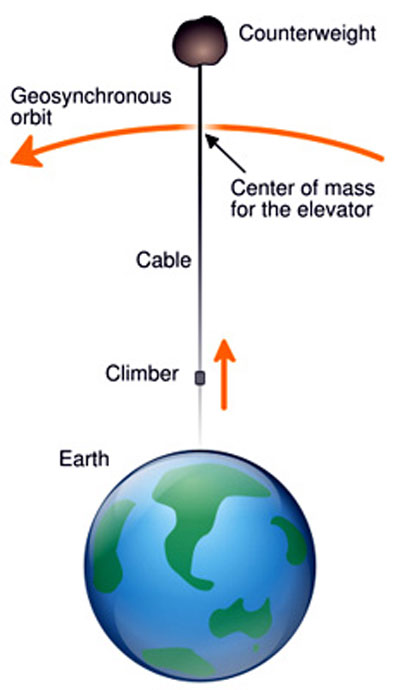 |
| Possibly not to scale. |
But then, around 2 years later I read in the Metro that this was exactly what scientists were working on. Had NASA stolen my idea? ....well no. A quick shufty on wikipedia tells me that the idea had been around for over 100 years.
Great minds, eh? This has to be my first proven genius idea. (and it surely is a genius idea - NASA's spent millions on the research already).
The 22-year-old me was so smart. I remember that day, I was on a roll. Later that afternoon I also came up with...
The Lunar Aqua-Park!
I also told my colleagues about this one. Genius it is... and before I explain it to you, please bear in mind that this can be done, but only in the far distant future... and by a company/person with extreme wealth and little consideration for the future of life on our planet.
The concept is a simple one: A water park on the moon. Can you imagine it? ...You'd have loads of water slides, shoots and swimming pools. All housed in some giant geodesic domes. It'd be like CentreParks in space. But of course, the difference being there is much less gravity on the moon. It'd be awesome.
Now here's the genius bit. ('What Jon? Was that not the genius bit already.... the general concept?' .... Well yeah, but it gets better.) One of the attractions in this park is a ride that tunnels through the ground right through to the centre of the moon ...and there would be a giant cavern carved out, and about 4 swimming pools worth of water dumped in there. The water would all float like a liquid sphere in the centre of the moon and people would dive in from all angles. I call it The Lunaquasphere™. How cool would that be in the centre?... swimming about with every direction being up. And also, because there's less gravity, you could dive in from much higher and not hurt yourself. Brilliant eh? ... Nothing can go wrong. Although, like I say, I've not really looked into the earthly repercussions of having a big hole into the centre of the Moon. If the Moon lost some of it's mass, it may actually affect the Earth's tidal patterns, seasons, the Moon's orbit round the Earth, and possibly even the Earth's orbit around the sun. It would certainly jeopardise the future of life on Earth... Still, imagine all the fun you could have in a Lunaquasphere™.
My Theory On Gravity: Part I (The Situation of the Gravity)
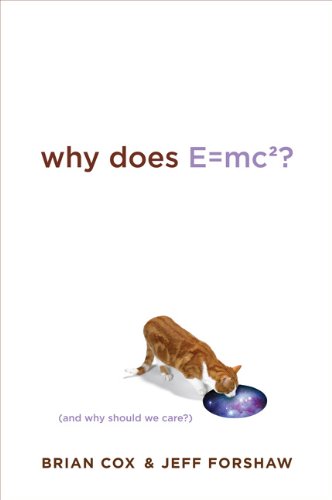 Having read Brian Cox(not that one)'s excellent book 'Why Does E=mc² (and why should we care?) last year, I discovered that scientists don't actually know what gravity is.
They know what causes a gravitational field (Mass) and how to calculate and indeed predict what gravity will be in any given scenario... but they don't know why it exists.
Also, the book tells of a universal equation, that accounts for everything... ever. It's about why everything is like it is, and behaves and looks the way it does, and accounts for 3 of the 4 known forces in the universe (the strong nuclear force, the weak nuclear force, and electromagnetism).
Gravity doesn't fit into the equation though. Which is why I came up with a theory...
My theory concerns the fact that gravity isn't really a force in itself, but the effect of distorted space-time. It goes something like this:...
Space-time is distorted around objects. If there was no matter in the universe, spacetime would be constant, but throw a few planets in there, and it's like pushing some marbles into a sponge. The marbles displaces the sponge... the sponge that is displaced is denser nearer the marbles. Perhaps that's a bad analogy...
But if space-time behaved in this way, if it was compressed outward somewhat (depending on the mass and density of the planet) then it would naturally want to spring back to it's original shape. This would mean there would be a constant natural force towards a planet... which would be greater if the planet was larger and/or denser. (this also explains the formation of a black hole when a star collapses)
The other 3 forces relate to how non-touching particles/atoms react around each other within space. Whereas the "force" of gravity is pertaining to the actual shape of space. so it can't be considered a force. ... Well it can, but it's not like the other 3. It's like (bad analogy alert!) comparing the attributes of 4 things, where 3 of the things are similar but very different, and the 4th thing is the universe.
The strength of gravity gradually dissipates the further from a planet you get.... to infinity apparently. You're still slightly affected by gravity of a planet on the other side of the universe (by an infinitely small amount), but you don't notice it much because of various other gravity creating phenomena closer to you. Particularly the planet you're standing on.
Anyhoo, in conclusion I will say that gravity doesn't and indeed can't fit in the universal equation because it's beyond it. To measure the distortion of space-time is like perhaps putting another dimension into an equation... To use one more analogy: When you know the maths to calculate out the exact area of a square when drawn on a flat piece of paper, then that's all good. But if you were a 2 dimensional being and all you knew was the 2 dimensional plane, then things would be different...When you draw the square on an apparently flat surface - but the surface was actually the surface of a sphere, then your calculations aren't going equal the actual area of the surface of the square you've drawn.
Any questions?
Subscribe to:
Posts (Atom)