Showing posts with label The Universe. Show all posts

08 December 2013

The Mysteries of the Universe


There are some big questions out there. Why are we here? What's life all about? Is there a god?
The answer to that last one is fairly obvious (No, of course there isn't. Grow up.), but as for the first two questions, I've been pondering whether the human race will ever figure it all out.

I guess non-specific questions of life, the universe and everything can be answered to some high degree of uncertainty by philosophers and genius-like sci-fi comedy writers, but I hope to look at it all from a scientific standpoint. ...Unfortunately, I seem to have mislaid own my personal standpoint (of the scientific variety) the last time I went time travelling, but I can pretty much recall the view from it.


At the cutting edge of physical science there are mysteries that have been left unanswered (although I know we have people working on them):

  • In the field of classical mechanics, there's What causes gravity? 

  • In the field of astrophysics, there's What is the shape/size of the universe?

  • In the field of quantum physics, there's the question Why does matter exist?


You may notice that these are all basically the same question. That question is How?
Or to be less succinct ... How did the universe form?
This is because all answers are easily revealed once you know the origin of the universe. Other big questions you may have thought of like How did life begin? can be answered with a simple sequence of 'cause and effect' that started when the universe began. Even little questions can be answered this way (although it isn't always necessary to go so far back): Can you explain Miley Cyrus' behaviour?... Well, first the universe came into existence...

Not only that, but I strongly suspect that if some genius (almost certainly not me*) is ever going to figure out the answer to just one of those big questions, then the answers to all the other questions will soon fall into place. And here's why (and how):
 
  • The 'force' of gravity is caused by physical matter distorting space-time. All matter does this but no one knows how. They only know that it does, and that it distorts all space-time in the universe. I suspect the answer will be perfectly obvious once they've figured out how matter came into existence.
 
  • Matter came into existence at the very beginning of the universe. We've currently got top men (and women) colliding particles under Switzerland to figure out what they're made of. In doing so, there may be some clue as to how they appeared from nothing. Which in effect is answering the question of how the universe came into existence.

  • Once we have a scientific model for the origin of the universe, then we can figure out the shape of it, the size of it now, and where we are in it. At the moment we can only see a mere 13.7 billion light years away. We have no idea where the centre is, whether it's even viewable from where we are, or which way is up.


Personally, I believe in the omniverse theory. Sometimes. Ok, it really depends on which day of the week you ask me. But whether that's true or not, I believe the key to it all lies in matter. Specifically the nature of gravity/space-time.

You see, matter is this big mystery. It's stuff that the whole universe is made of, and it all sits in a 4 dimensional web of space-time (which incidentally, was also created at the birth of the universe). The two things are inextricably linked. Matter affects the whole universe and the whole universe is made of matter. They are one and the same. This is how matter came into being from nothing; it was all extrapolated from nothing, and the remnant of the 'nothing' that was left over, is the space-time continuum.

Therefore, to figure out the true nature of matter, is to figure out the true nature of everything.


But can it be done?

Science has come a very long way, in a very short space of time. I know that more hurdles will be overcome in the following decades which will give some clues to all this, as well as sparking new questions. However...

The answers are getting progressively difficult to obtain. Science is getting better still, but it's slowing down. I predict that if it's gonna happen at all, then the answers will start to flood in thick and fast, within the next 65 years. But after that, I don't think we'll ever figure it out.
Ask me in 30 years time, and I'll give you a more accurate prediction. But right now there's a 50/50 chance of us finding the answers in the next 65 years, though there's only a 10 percent chance of that.


* I'm so modest these days.

13 September 2013

The Size of the Universe

Whilst we're taking about what scientists don't know, dark energy isn't the only bollocks phrase they've invented to explain things they don't know. The other one is dark matter (not to be idiotically confused with anti-matter). This was invented to explain away the reason why they can't account for the massive lack of mass in the universe.

Again the answer is obvious. All the mass in the viewable universe only accounts for about 4% of all the mass there should be. The remaining 96% lies in the areas of space we can't see, because they exist more than 13.7 billion lightyears away. Cosmologists think this is wrong because they've misjudged the current size of the universe, by assuming that they know it's current speed. Mystery solved.

It just goes to show, if you make an ill-informed, half thought out assumption in one instance, it'll have a logical knock on effect for all the rest of your reasoning. Obviously all of my scientific arguments are flawless and impeccable, so there's absolutely no reason to even doubt their credibility. All have been scientifically peer reviewed by the equally genius and sound mind of my assistant Ziggy, the invisible time-travelling hamster.

11 September 2013

The State of the Universe (aka Gravity Part V)

There's a fairly large question about the universe that cosmologists have been unable to definitively answer, and that's 'Why does the universe look like it does?'. An amazingly simple question, I think you'll agree, and it doesn't take a genius to come up with an amazingly simple answer to this question... or perhaps it does.

In the likely event that you're in the dark as to what the universe looks like, let me enlighten you. This universe (for it is probable that there are many) is comprised of a few hundred billion galaxies. These galaxies are not scattered completely randomly, but are instead spread out in a three dimensional stringy web-like pattern. A good analogy that has been made for this is a load of washing-up bubbles, where the washing-up liquid that makes up the bubbles themselves represent the galaxies, and the air within the bubbles represents the vast gaps of nothing in the universe.


Theoretical physicists have the problem that they don't know how the universe got into this state. Well, it seems pretty obvious to me. I mean, I'm no astrophysicist, but it's hardly rocket science: The galaxies remain in a stretched out web pattern because matter naturally distorts space-time, which has an instantaneous effect on the propagation of any and all matter relative to both the distance and the combined mass of any and all of the masses within the system. The net effect of all of this intergalactic mass is a sort of mass intergalactic net effect, and the appearance of the universe as it has been observed fits in exactly as predicted by the above model.

You probably realised that this is a description of gravity, but I really wanted to explain what is happening without confusing matters... and people seem to get confused whenever someone mentions the G-word. They think it's a force or something!  ...the idiots.

So what's the prob?
The cosmic boffins still have the issue of explaining why the universe is still expanding, when gravity should've started making it contract by now. They've attributed this to Dark Energy [cue mystical/scary music].
Dark energy is just a phrase they've invented, because they can't think of they're own explanation that doesn't involve magic, witchcraft, god or anything else made up.


It all seems quite self-evident to this genius: The universe is still expanding because the explosion that created this universe was bloody massive. You can't even begin to imagine how big it was. Sure, the effect of gravity has slowed the expansion substantially since the universe began, but that's small beans compared to how fast it was originally going at 13.7 billion years ago. Back then it was all relatively pretty close to the cosmic speed limit. So of course gravity hasn't put the breaks on fully. If/when that eventually happens, our universe will start to contract slowly. But then as time goes on, the speed of contraction will continue to accelerate... to the point that it will eventually reach a point (by which I mean a singularity) just at the point when the relative speed reaches the cosmic speed limit of the universe.

03 March 2013

The Speed of the Universe


"People often ask me about the universe..." says the daft-punk speak'n'spell robot voice controlled by supposed genius Professor Stephen Hawkings. Well people would ask him wouldn't they. But then people are stupid. Believe me I've met a few.

Today (and over the next few days/weeks) I'm going to tell you about the universe... (yes, I am aware you never asked). I'm going tell it how it really is and point out where current science has got it wrong.
First up, the speed of the universe.


It is currently trendy in cosmological circles to believe that the universe is expanding. Not only that, but expanding at an accelerating rate too.

This is nonsense.

The universe is not accelerating. It is definitely decelerating. Not only that but it's possible it could have come close to stopping expanding all together. You want proof? ... Gravity.

The effect of gravity generally makes matter attract other matter. This is why the universe is and always has been slowing down. If the effect of gravitation didn't exist, the universe still wouldn't be accelerating. It would just keep expanding at the same speed. That's Newton's first law right there; the law of inertia.

So what we have is an expanding universe that is not naturally inclined to speed up, even before we include gravity. Once we add effect of gravity to this universe as well as the resulting effect of friction, we have a universe that is definitely slowing down. As a result of gravity and friction in our universe, matter (particularly solid matter) generally doesn't like to be stretched.

Ahhh, you say, but what about the red spectrum shift that proves that all galaxies are spreading out and that the ones furthest away are getting further away faster?
You're not thinking fourth dimensionally!(as the creator of time travel will famously say). I agree those farthest galaxies are expanding toward the outer universe and they are expanding at a faster rate than the nearer galaxies. But you forget, those galaxies at the edge of the viewable universe are 13.7 billion light-years away. We're looking at that area of space the way it was 13.7 billion years ago. It's has taken that long for their light to reach us.

Now lets look at a relatively close neighbouring galaxy, Andromeda. It's only 2.5 million light-years away. Like all galaxies, it is getting further from us, but not at nearly the same rate as those at the edge of the viewable universe. When we view Andromeda, we're seeing it as it was just 2.5 million years ago.

Let's look at those (very approximate) figures again...

Edge of the observable universe as seen:  13,700,000,000 years ago.
The Andromeda galaxy as seen:                            2,500,000 years ago.

So in conclusion, things were flying about much faster a long long time ago, and things are flying about a lot more slowly more recently. Therefore:

The expansion of the universe is slowing.  Q.E.D.

Ha! In your face, Hawkings!

Also I should add that my claim that the universe has now almost come to a stop is based upon the the above fact, the known age of the universe, and the known effects of gravity.
I postulate that at this very moment, at the actual edge of the universe (that we cannot see), the current speed of those galaxies will not be much faster than the relative speeds of the nearby galaxies in the local vicinity.

Can someone get Professor Brian Cox on the phone, I have some news for him.


28 July 2011

Gravity Part III: The End (The Life of the Universe ...and Everything)

The universe is an interesting place. I should know, I've lived in it most of my life. But how did it get here? Will it be here forever? And if not, what happens when it dies?
Various theories have been bandied about on the subject of the universe's longevity. It seems that the scientific community's jury is still out on these matters, so I think it only right for a probable genius such as myself to illuminate the truest most probable scenario.
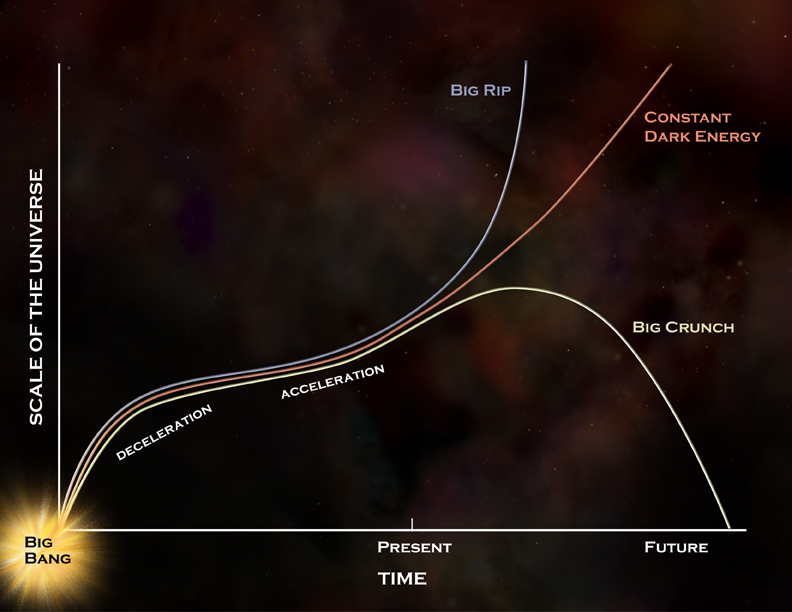
Current scientific speculation about the universe. All wrong for the most part.

Gravity is the key to the end of time. Of the current opinions, the most common ones suggest that either all mass in our universe will stop accelerating away from each other and then gravity will make it fall back on itself (The Big Crunch) ...or all the galaxies in the universe will continue to get further and further away from one-another, in which case after a stupidly long period of time, entropy will set in, everything will cool down and break up into their component atoms until they simply disappear. And the end of matter in the universe means the end of time itself. It is believed that this second scenario is the more likely of the two, because there currently isn't enough known matter in the universe for the first scenario to happen. Well I'm here to tell you that both of these scenarios are wrong...
...sort of.

It is my (unquestionably correct) opinion that the universe is infinite. That is to say that it's always been here. There is no start and there is no end. But there are cycles of similar (but not identical) repetition within. Time and space in the universe are not constant. They are infinite, however I will concede that it is acceptable to call them finite as time and space can only be measured in relation to something else. They are concepts that are relative to the observer and it is impossible to view the space-time continuum in a non-objective way. When I refer to the universe then, I am of course referring to everything and not perhaps 'the universe' as you would understand it.
Perhaps I should redefine this term. It is my belief that the universe as we know it is in fact just a small part of a wider universe. A multiverse or omniverse if you will. I will opt to call it the latter as multiverse suggests that the whole thing is just made up of multiple universes, but it's a bit more complex than that. Omniverse seems the right word to me at it means 'all', and in this case we truly mean all.

To begin with I reasoned the following idea to be a plausible model for an infinite omniverse:
All the galaxies in our universe are getting further away from each other... As there isn't enough matter to pull it all back together (because antimatter is probably responsible long ago for the annihilation of a great number of galaxies in our universe, hence the gaps. See Gravity Part II for more details on this phenomenon.), all the galaxies will spread out and disintegrate as mentioned in the 2nd scenario above. Eventually after what can be described as a literal eternity, all that's left of these vastly sparse galaxies is an innumerable number of basic component atoms. But this is where gravity comes back in, because even in an infinite universe with a finite number of atoms,... given a long enough time period (and we're talking an infinite time period here), all it takes is two of these atoms to collide in order to attract further atoms from across the endless cosmos. I should remind you that matter has a gravitation affect on all other matter in the universe, no matter the matter of the distance from the matter. It may sound fairly unlikely, but even if the effect of gravity didn't exist, so long as the atoms are moving and given an infinite amount of time these atoms will find each other... every time. So this is how new universes are born from dead universes. And that cycle goes on and on forever.

So, are you with me so far? Did you understand the basic principle laid out in the last paragraph. Okay, now I'd like you to forget about all of that, because as I said, the above was just my initial reasoning and I'd like you to see some of the workings of a genius mind such as my own. The true nature of the universe is so much more beautiful than that. It is far more complex, and yet it is a simpler solution at the same time. Allow me to explain in such terms that even a non-genius (such as yourself) can understand:...

My ultimate theory on the infinite universe states that there is only one universe. There are however an infinite number of universes that exist in a reality of there own. I call this a dimension-straddling omniverse. The basic model goes along with current scientifically known fact; there is a big bang, the universe is created, and then there's some time.... and 'some time' later the universe dies. The End.
Except it is not the end. It doesn't answer the question of what caused the big bang in the first place. It ultimately has to do with gravity. When a sun goes supernova and collapses in on itself it become a black hole. These black holes create new universes within the 5th dimension. The term 'black hole' is perhaps a bad description for the phenomena. It may appear black (because light cannot escape it's gravity) but it is not a hole. It is a singularity that sucks in matter, light and time. Effectively it's a pinched section of space-time.

The 3D black-hole effect on a 2D universe.

It may help you to imagine this on a 2D plane rather than the 3D plane we're used to. If space-time is represented by a tablecloth then a black hole would be represented by the effect that a vacuum cleaner would have when applied to that tablecloth. The hoover bag in this analogy represents a new universe. But this cosmic carpet cleaner is not within the 2D universe we know, it exists within an extra dimension.


Now lets add a couple of dimensions to the above tablecloth/hoover scenario. We have the 4 dimensional universe of space-time that we know and love, and then we have the 5 dimensional omniverse that consists of numerous 4D universes.
This all ties in neatly with my theory that gravity itself is caused by gaps in space-time displacing the continuum, as stated in Gravity Part I.

So, ... every black hole in our universe will create another universe. And our universe was created by the black hole phenomena of another universe. Although our universe is massive, it is also finite, and so every universe will create a finite number of universes. How many? ...depends on how many black-holes are created in a universe.

This* is not a literal representation of the omniverse.
At this stage the numbers don't really matter. Perhaps the effect of all black holes in one universe combine to create the same universe and so you would only ever get one new universe created out of the previous one. Or perhaps numerous universes are created from one, the number of which would entirely depend on the mass content and/or relative gravity of any given source universe. And some of those universes won't contain enough matter for gravity to take effect to cause more black-holes, but some would, and therefore create numerous universes within the 5D omniverse. Either way, each and every universe will have a finite lifespan, but the omniverse will be infinite. Every universe will be the product of every universe before it, and in theory all these can run parallel with each other: They don't have to happen sequentially in time as we're talking about space-time making more space-time outside of space-time. The effect will be like some kind of beautiful infinite cosmic omniversal fractal pattern. For every black hole, a universe is created, and within every universe that is created at least one (but more likely numerous) black-holes will form. It goes on forever. A universe is born and will die but the omniverse has no beginning or end. It's kind of like life. So long as life is around, more life will be created given the right circumstances. And as long as there is matter in the universe (any universe) then further universes will be created. Such is the nature of the omnivese, it has always been here and will always be here.

All the above is fact. Some of these facts may yet to be proven as 'facts', but that's for the scientific community to get it's head around. I don't have the time to wait for these supposed experts to catch up. Nor do I possess the time or resources to devote my life to such a simple (and obvious) cause as the nature of the omniverse. But take my word for it, this is the way it is. Fact.

Oh and for all the people with faith who believe that God created the universe: Some of you might want to embrace this new wisdom of mine, and try and explain that this scenario still fits with in your beliefs; that each universe is indeed created by an unknown higher power, that the vacuum cleaner in my earlier analogy is in fact God Himself, constantly creating universes from the remnants of previous universes, and technically being 'omni-present' within the 5 dimensional omniverse.... Well it isn't. It's not him. He doesn't exist. Get over it!


* Just some nice art work (admittedly pilfered from someone else's site) which nicely illustrates the infinite and procreative nature of the omniverse. It obviously doesn't look like that. The universes aren't even sharing the first four dimensions. Don't take it literally.